Picture this: It’s the middle of February, snow is falling gently outside your kitchen window, and you’re preparing a salad with kale, spinach, and Asian greens harvested from your backyard just minutes ago. While your neighbors are paying premium prices for shipped produce that’s traveled thousands of miles, you’re enjoying vegetables so fresh they’re still cold from the garden.
This isn’t a fantasy reserved for professional farmers or people with expensive greenhouse setups. This is winter vegetable gardening, and it’s one of the most rewarding—and surprisingly forgiving—forms of growing food at home.
After years of trial, error, and more than a few spectacular failures, I’ve cracked the code on successful winter gardening. This comprehensive guide will walk you through everything you need to know, from selecting the right cold-hardy varieties to protecting your crops during brutal cold snaps, all while avoiding the costly mistakes I made when starting out.
Why Winter Vegetable Gardening Deserves Your Attention
The Unexpected Benefits of Cold-Season Growing
Most gardeners hang up their gloves after the first frost, assuming their growing season has ended. What they don’t realize is that winter gardening actually offers several distinct advantages over summer cultivation:
Reduced pest pressure: The insects that plague summer gardens—aphids, squash bugs, tomato hornworms—are either dormant or dead during winter months. This means fewer battles with destructive pests and less need for intervention, whether organic or conventional.
Read more – 7 Fastest Growing Vegetables You Can Harvest in Just Weeks
Lower water requirements: Winter crops require significantly less irrigation than their summer counterparts. Cool temperatures mean slower evaporation rates, and seasonal precipitation often handles most watering needs. I’ve gone entire weeks without watering my winter garden, something unthinkable during July and August.
Minimal weed competition: Cold weather slows weed germination and growth to a crawl. The aggressive weeds that can overtake a summer garden in days become almost non-existent in winter, drastically reducing maintenance time.
Superior flavor development: Here’s where winter gardening gets truly exciting. Many cold-hardy vegetables undergo a remarkable transformation after exposure to freezing temperatures. The biochemical process is fascinating: as temperatures drop, plants convert stored starches into sugars as a natural antifreeze mechanism. The result? Brussels sprouts, kale, parsnips, and carrots develop a sweetness and complexity of flavor that’s impossible to achieve in warmer months.
My Brussels sprouts taste aggressively bitter when harvested in early fall. After several hard frosts below 25°F, these same plants produce sprouts that are nutty, sweet, and genuinely addictive. This dramatic flavor improvement alone justifies the effort of winter gardening.
Essential Winter Vegetables: Tested Varieties That Actually Work
Fall-Planted Crops for Spring Harvest
Garlic (Allium sativum): No winter garden is complete without garlic. This allium requires a cold period (vernalization) to form proper bulb division, making it perfectly suited for fall planting and spring harvest.
Timing is critical. Plant individual cloves approximately six weeks before your soil freezes solid—typically October in zones 5-6, November in zones 7-8. This window allows roots to establish before winter dormancy but prevents premature top growth that could be damaged by severe cold.
Variety selection matters. Hardneck garlic varieties thrive in cold climates (zones 6 and below), producing fewer but larger cloves with complex, robust flavors. Softneck varieties perform better in warmer regions (zones 7 and above), offering longer storage life and the braiding capability many gardeners appreciate.
Broad Beans/Fava Beans (Vicia faba): These legumes are winter gardening superstars. They tolerate temperatures down to 12°F once established, making them suitable for growing in most temperate climates. Beyond their cold tolerance, fava beans fix atmospheric nitrogen through symbiotic root bacteria, enriching your soil while they grow—essentially providing free fertilization for subsequent crops.
Plant fava beans in late fall (October-November in most regions). They’ll establish roots during winter and surge with growth as spring arrives, often producing harvests before summer vegetables are even transplanted.
Vegetables for Cold Frames and Season Extension
Spinach (Spinacia oleracea): Spinach demonstrates remarkable cold hardiness, surviving temperatures into the low teens Fahrenheit with minimal protection. I’ve observed spinach plants buried under three inches of snow emerge completely unscathed after thawing—no wilting, no damage, just ready to harvest.
For winter production, choose cold-hardy varieties like ‘Bloomsdale Long Standing,’ ‘Winter Giant,’ or ‘Space.’ These cultivars have been specifically bred for cold tolerance and will outperform standard varieties under winter conditions.
Asian Greens: This category encompasses numerous species that excel in cold weather: mizuna, bok choy, tatsoi, komatsuna, and various mustard greens. These vegetables grow surprisingly quickly even during short winter days, and their spicy, peppery flavors add welcome complexity to winter salads and stir-fries.
Read more – Best Vegetables and Herbs for Indoor Farming
Most Asian greens tolerate temperatures into the mid-20s°F with row cover protection and continue growing slowly even when temperatures hover around freezing. Their rapid growth rate (many mature in 30-45 days) makes them ideal for succession planting throughout fall and early winter.
Kale (Brassica oleracea var. sabellica): Kale’s reputation as a cold-hardy superfood is well-deserved. This brassica not only survives freezing temperatures but actually improves in flavor after frost exposure. The starch-to-sugar conversion that occurs in cold weather eliminates much of kale’s inherent bitterness, producing leaves that are sweeter and more tender.
‘Winterbor,’ ‘Red Russian,’ and ‘Lacinato’ (also called dinosaur kale) are excellent winter varieties. Plant these 70-90 days before your first expected hard freeze to ensure plants reach full size before winter dormancy.
Swiss Chard (Beta vulgaris subsp. vulgaris): Often overlooked in winter garden planning, Swiss chard tolerates cold remarkably well. While the stems may become less tender in freezing weather, the leaves remain productive and flavorful throughout winter with basic protection.
Lettuce—With Important Caveats: Not all lettuce varieties can handle winter conditions. Tender butterhead and looseleaf types often turn to mush after hard freezes. Success depends on choosing winter-specific varieties bred for cold tolerance.
‘Winter Density,’ ‘Arctic King,’ ‘North Pole,’ and ‘Winter Marvel’ are specifically developed for cold-season production. These varieties form dense, compact heads that resist frost damage and maintain quality throughout winter. The naming convention—notice all these varieties reference cold or winter—should guide your selection process.
Critical Timing: The Make-or-Break Factor in Winter Gardening Success
My single biggest early mistake was casual, imprecise planting timing. I treated fall planting like spring planting, assuming plants would simply grow until harvest regardless of when I put them in the ground. This approach failed spectacularly.
Understanding the 10-Hour Daylight Rule
Winter crops follow different growth patterns than summer vegetables. The critical threshold is 10 hours of daylight. Once your location drops below 10 hours of daylight per day (typically November through January in most of the continental United States), plant growth essentially stops. Vegetables don’t die—they enter a holding pattern, maintaining their current size without producing significant new growth until daylight increases again in late winter.
This means your winter crops must reach full harvestable size before daylight drops below that 10-hour threshold. You’re working backward from this date, not forward from your first frost date.
Calculating Your Planting Windows
For most winter vegetables in zones 5-7, this translates to planting windows between late August and early October. Specific timing depends on your exact latitude (which determines your daylight hours), your first frost date, and each crop’s days-to-maturity.
Here’s my practical approach: I maintain a garden calendar with specific planting dates for each crop. I set phone reminders two weeks before each planting window. This system eliminates guesswork and ensures I don’t miss critical planting deadlines because I got busy with work or life obligations.
The most common mistake I see other gardeners make—and the one I made repeatedly my first year—is planting too late. If you’re uncertain about timing, plant earlier than you think necessary. A slightly oversized kale plant survives winter better than a tiny seedling struggling to establish.
Season Extension and Plant Protection Strategies
Affordable Protection Methods That Actually Work
You don’t need a $5,000 greenhouse for successful winter gardening. My first winter garden used approximately $15 in PVC pipes and some floating row cover fabric from the local hardware store. Total investment: under $50 including seeds. This basic setup provided enough protection to keep greens producing through multiple snowfalls and temperatures down to 15°F.
Floating Row Covers: These lightweight, breathable fabrics provide 2-4°F of frost protection while allowing light, air, and water to penetrate. They’re perfect for extending the season by a few weeks or protecting during unexpected cold snaps.
Thickness matters. Row covers come in different weights, typically ranging from 0.5 oz/sq yard (lightest) to 2.0 oz/sq yard (heaviest). Lighter weights provide minimal protection but maximum light transmission. Heavier weights offer better frost protection but reduce light penetration—important during already short winter days.
I use medium-weight covers (0.9-1.0 oz/sq yard) for most applications, reserving heavy covers for extreme cold events.
Cold Frames: These structures provide significantly more protection—typically 10-20°F temperature boost over ambient conditions. A cold frame is essentially a bottomless box with a transparent lid, creating a mini-greenhouse effect that captures and retains solar heat.
You can build effective cold frames from inexpensive materials. I constructed my first cold frame using salvaged windows from Facebook Marketplace ($20 for four old storm windows) and scrap lumber. This simple structure has survived six winters and continues protecting crops reliably.
The key is orientation. Position cold frames facing south (in the Northern Hemisphere) to maximize solar heat collection during short winter days. Ensure the lid opens easily for ventilation on sunny days—even in winter, temperatures inside a closed cold frame can reach 80-90°F on clear days, potentially damaging plants.
The Layering Strategy: During extreme cold events, combine protection methods. During one particularly brutal cold snap (temperatures dropped to -5°F, far below normal for my zone 6 garden), I layered row covers directly over plants, then closed my cold frame lids over the covered plants, then draped an additional tarp over the cold frames for extra insulation.
This probably looked ridiculous to neighbors, but everything survived when unprotected plants in the neighborhood died. The principle is simple: multiple layers of protection trap additional insulating air spaces, dramatically improving survival odds during extreme events.
Winter Garden Maintenance: Less Work Than You’d Think
Watering in Cold Weather
This aspect trips up most beginning winter gardeners. The common assumption is that dormant or slow-growing plants don’t need water. This is incorrect.
Winter vegetables still require moisture, just significantly less than actively growing summer crops. The challenge is timing your watering correctly.
My approach: Check soil moisture weekly by feeling the soil several inches deep. If the top 2-3 inches are dry and no precipitation is forecast, water on a morning when temperatures will remain above freezing throughout the day. This allows water to penetrate soil before freezing night temperatures arrive.
Read more – The Best Companion Herbs to Grow with Vegetables
Never water when soil is frozen or when temperatures won’t rise above freezing during the following 24 hours. You’re essentially creating ice around roots, which can cause more damage than drought stress.
Snow counts as watering. A 4-inch snowfall typically equals approximately 0.5 inches of water once melted—often sufficient to meet winter crop needs for 1-2 weeks.
Mulching Protocol
Mulching winter gardens requires different timing than summer mulching. The critical rule: wait until after the ground freezes before applying winter mulch.
I learned this principle the hard way. My first year, eager to protect plants, I mulched heavily in October while soil was still warm. I created a perfect habitat for mice, voles, and other rodents seeking insulated winter quarters. They moved into my mulch and proceeded to eat my garlic, nibble on plant crowns, and generally cause havoc.
Now I wait. Once the ground freezes solid (typically late November or December in my location), I apply 2-3 inches of straw mulch. This layer prevents the damaging freeze-thaw cycling that heaves roots out of soil but doesn’t provide cozy rodent housing since the ground beneath is already frozen.
Avoid leaf mulch for winter gardens. Leaves mat down when wet, creating an impermeable barrier that can suffocate plants and encourage fungal diseases. Straw, on the other hand, provides insulation while maintaining air circulation.
Weekly Garden Checks
Despite lower maintenance requirements, winter gardens benefit from regular monitoring. Every week, bundle up and spend 15 minutes walking through your winter garden:
- Check for animal damage: Deer, rabbits, and rodents find winter gardens attractive when other food sources are scarce. Look for browse damage, tracks, and droppings.
- Inspect protection structures: Verify that row covers remain anchored, cold frame lids haven’t blown off, and structures remain intact after wind or snow events.
- Monitor for disease: While less common in cold weather, fungal diseases can still develop, especially in covered areas with poor ventilation.
- Clear snow when necessary: While snow provides insulation, extremely heavy snow loads can break branches on Brussels sprouts plants or collapse lightweight protection structures.
This weekly investment prevents small problems from becoming garden disasters.
Harvesting Your Winter Bounty
Cut-and-Come-Again Harvesting
Many winter greens—kale, chard, Asian greens, and spinach—respond well to cut-and-come-again harvesting. This method involves harvesting outer leaves while leaving the growing center intact, allowing the plant to continue producing new leaves.
Start harvesting once plants reach usable size, typically when they have 5-6 true leaves. Remove only the outer 30-40% of leaves during each harvest, working from the outside in. The plant’s growing tip remains undisturbed and continues producing new foliage, providing harvests over several months from a single planting.
This technique maximizes yield from limited garden space and ensures continuous production throughout winter.
Root Vegetable Harvesting
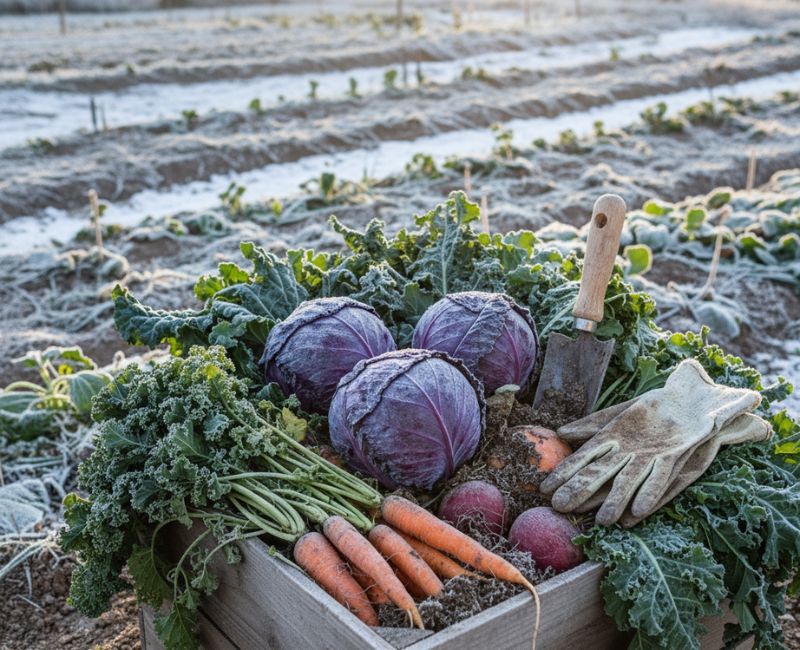
For root vegetables like carrots, parsnips, and beets, your garden essentially becomes a root cellar. These crops can remain in the ground all winter, harvested as needed. In fact, many root vegetables improve in flavor after remaining in frozen ground for extended periods.
Mark rows clearly before heavy snow arrives—it’s surprisingly difficult to locate carrots under 6 inches of snow. I use tall stakes or colored flags to mark root vegetable locations.
To harvest from frozen ground, I sometimes use a garden fork to loosen soil around roots a day before I need them, making extraction easier. Alternatively, harvest roots during brief thaws when soil softens temporarily.
Brussels Sprouts: Patience Rewarded
Brussels sprouts require patience. These vegetables taste genuinely terrible when harvested before cold weather—bitter, sulfurous, and unpleasant. After several hard frosts (temperatures below 25°F), the same sprouts transform into sweet, nutty vegetables.
Harvest Brussels sprouts from the bottom of the stalk upward. Lower sprouts mature first and receive the most cold exposure. The topmost sprouts are always the last to develop sweetness. I typically begin harvesting in December and continue through February, working my way up the stalk as sprouts improve.
Common Mistakes and How to Avoid Them
Problem: Root Rot from Overwatering
The Mistake: Assuming winter plants need regular watering like summer crops.
The Solution: Water only when soil is actually dry and only on mornings when temperatures will remain above freezing. Remember that winter plants use water much more slowly than actively growing summer vegetables.
Problem: Suffocating Plants with Excessive Protection
The Mistake: Covering plants too heavily or leaving covers on continuously without ventilation.
The Solution: All plants require air circulation, even in winter. Vent cold frames on sunny days. Remove or lift row covers periodically to allow air exchange. Watch for condensation buildup under covers—excessive moisture encourages fungal diseases.
Problem: Planting Too Late
The Mistake: Missing critical fall planting windows, resulting in plants that are too small to survive winter.
The Solution: Calculate backward from your 10-hour daylight date. Each crop needs a specific number of days to reach maturity. Add extra buffer time for safety. When in doubt, plant earlier rather than later.
Problem: Wrong Variety Selection
The Mistake: Planting summer varieties and expecting winter performance.
The Solution: Choose varieties specifically bred for cold tolerance. Pay attention to variety names—’Winter,’ ‘Arctic,’ ‘Snow,’ and similar names indicate breeding for cold conditions.
Getting Started: Your First Winter Garden
If you’re new to winter gardening, resist the temptation to plant everything at once. Start with a modest selection of reliable, forgiving crops:
Year One Recommendations:
- Garlic (plant in fall, harvest next summer)
- Kale (choose one winter variety)
- Spinach (incredibly forgiving)
- One Asian green (mizuna or bok choy)
This simple combination provides diverse flavors and textures while teaching you fundamental winter gardening principles. More importantly, it’s a manageable workload that won’t overwhelm you.
Keep detailed notes throughout your first winter. Record planting dates, first harvest dates, which varieties performed best, and which protection methods worked in your specific microclimate. This information becomes invaluable reference material for subsequent years.
Weather patterns, soil conditions, and microclimates vary significantly even between neighboring properties. What works perfectly in my garden might need modification in yours. Treat your first winter as an educational experiment rather than expecting perfect results.
Year Two and Beyond
Once you’ve successfully grown a simple winter garden, gradually expand your crop selection. Try brussels sprouts (they require more planning but deliver spectacular results). Experiment with winter lettuce varieties. Plant more garlic than you think you’ll need—you’ll use it.
The learning curve for winter gardening is surprisingly gentle. Each season builds on previous experience. Your second winter will be substantially easier than your first. By your third winter, you’ll wonder why you ever thought winter gardening was complicated.
The Real Reason to Start Winter Gardening
Beyond the practical benefits—cost savings, superior flavor, food security—winter gardening connects you to your outdoor space during months when most people retreat entirely indoors. There’s something deeply satisfying about harvesting fresh vegetables while snow falls, about maintaining a productive garden when conventional wisdom says nothing should be growing.
That February morning when you’re eating a salad with ingredients harvested from your backyard while your neighbors are paying $6 for sad, wilted supermarket greens that were picked two weeks ago and traveled 2,000 miles? That moment crystallizes why winter gardening enthusiasts are so passionate about this practice.
Start small. Learn from your inevitable mistakes. Take notes. Adjust your approach based on your specific conditions. Next year will be better than this year, and the year after that will be better still.
Winter gardening isn’t mystical or impossibly difficult. It’s simply regular gardening with a coat on, growing crops that actually prefer cold weather. Your plants are tougher than you think, and you’re more capable than you realize.
Helpful Resources and References
- USDA Plant Hardiness Zone Map – Determine your growing zone for appropriate variety selection
- Old Farmer’s Almanac Frost Dates – Find your local first and last frost dates for timing calculations
- National Gardening Association – Extensive resources on cold-season vegetable growing
- Johnny’s Selected Seeds Winter Growing Guide – Excellent variety selection and detailed growing information for cold-hardy crops