
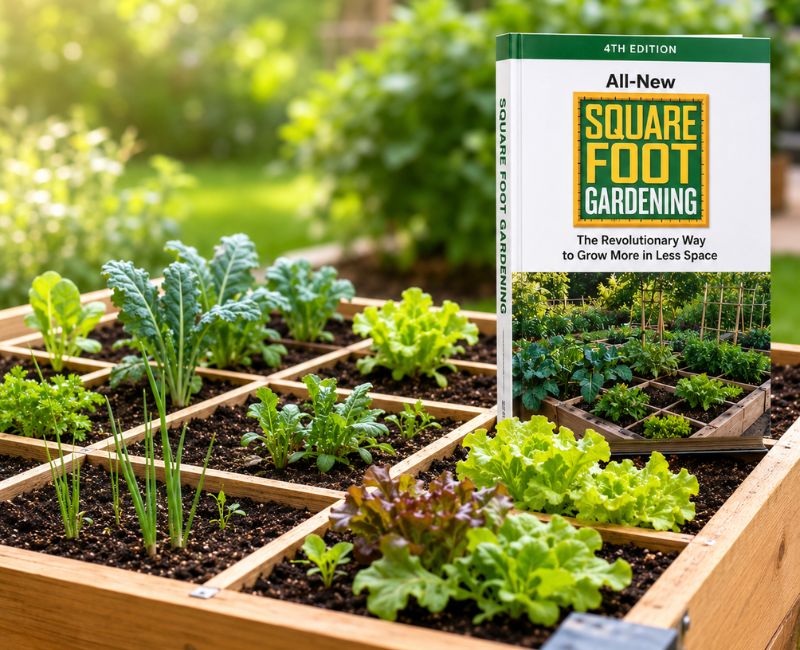
If you’ve been growing vegetables in a raised bed, chances are Mel Bartholomew’s Square Foot Gardening method has crossed your path. Now in its 4th Edition, the book has been updated for modern growers and the changes are more significant than a simple reprint. From revised plant spacing charts to sustainability-first soil recipes, the 2026 edition reflects how gardening has evolved over the last decade.
In this guide, we break down exactly what’s new, what’s stayed the same, and whether the 4th Edition is worth buying if you already own an earlier version.
What Is Square Foot Gardening? (A Quick Definition)
Square Foot Gardening (SFG) is an intensive planting method developed by Mel Bartholomew in 1981. The core idea is simple: divide a raised bed into a grid of 1-foot squares, then plant a specific number of crops in each square based on the plant’s size. A single square might hold 16 radishes, 9 beets, 4 lettuces, or just 1 tomato plant.
The method is designed to eliminate wasted space, reduce weeding by up to 80%, and make gardening achievable for people with limited land, time, or experience. Over 3 million copies of the original book have been sold worldwide, making it one of the best-selling gardening books of all time.
What’s New in the 4th Edition of Square Foot Gardening?
The 4th Edition, updated for 2026, was developed by the Square Foot Gardening Foundation to keep the method aligned with contemporary growing challenges including climate unpredictability, peat moss shortages, and the surge in urban and balcony gardening.
1. Updated Mel’s Mix Formula
The original Mel’s Mix equal parts peat moss, coarse vermiculite, and blended compost has been revised. The 4th Edition now officially offers peat moss alternatives, acknowledging growing environmental concerns and regional availability issues. Coconut coir is the primary recommended substitute, offering similar moisture retention without the sustainability drawbacks.
See our full guide: Mel’s Mix Alternatives: What to Use When Peat Moss Isn’t Available
2. Revised Plant Spacing Charts
One of the most practically useful updates is the expanded plant spacing section. The 4th Edition includes:
- Updated spacing for heat-tolerant varieties developed post-2020
- New charts for root vegetables including parsnips, turnips, and newer carrot cultivars
- Spacing recommendations for vertical crops in small-space SFG setups
3. Climate-Adaptive Planning Sections
Climate volatility is addressed head-on in the new edition. A dedicated chapter covers:
- Planting adjustments for hardiness zone shifts (many US gardeners are now 1 zone warmer than in 2010)
- Drought-resilient crop selection for SFG beds
- Season extension strategies including hoop tunnels and cold frames integrated directly into the SFG grid system
Related: Square Foot Garden Plans for Extreme Weather & Deer Protection 2026
4. Expanded Vertical Gardening Content
The 3rd Edition touched on vertical growing, but the 4th Edition dedicates a full section to it. This includes:
- Grid-integrated trellis systems
- Crop pairing for vertical and horizontal growing in the same 4×4 bed
- New archway and hoop tunnel designs that work within the SFG framework
Explore: DIY Trellises, Hoop Tunnels & Archways for Square Foot Gardens
5. Introduction of “Top Hat” Boxes for Root Crops
A brand-new technique introduced in this edition is the “Top Hat” box an elevated add-on frame placed on top of an existing SFG bed to give deep-rooted vegetables like carrots and parsnips the extra soil depth they need without rebuilding the entire bed.
Deep Dive: Top Hats for Root Crops: New Square Foot Gardening Technique Explained
6. Sustainability & Eco-Conscious Updates
The 4th Edition integrates sustainable gardening principles throughout, rather than treating them as add-ons:
- Water conservation techniques built into every bed plan
- Companion planting charts updated with pollinator-friendly combinations
- Guidance on composting within the SFG system to reduce bought inputs over time
How Does the 4th Edition Compare to Previous Editions?
| Feature | 1st Edition (1981) | 3rd Edition (2013) | 4th Edition (2026) |
|---|---|---|---|
| Core Grid System | 1-ft square grid | 1-ft square grid | 1-ft square grid (unchanged) |
| Mel’s Mix Recipe | Peat moss based | Peat moss based | Coir alternative included |
| Plant Spacing Charts | Basic 30 crops | ~50 crops | 60+ crops, heat-tolerant varieties |
| Climate Guidance | None | Brief mention | Full chapter, zone-shift aware |
| Vertical Gardening | Not covered | Brief section | Full dedicated section |
| Root Crop Depth Solutions | None | Not addressed | “Top Hat” box technique |
| Sustainability Focus | Minimal | Moderate | Integrated throughout |
| Urban/Balcony Adaptation | Not addressed | Some content | Significant coverage |
Is the 4th Edition Worth Buying If You Own an Earlier Copy?
This depends on your situation:
Buy the 4th Edition if:
- You’re struggling with peat moss availability or cost
- Your growing zone has shifted and your old timing advice feels off
- You want to grow root crops deeper than your current bed allows
- You’re new to vertical growing within an SFG framework
You can skip it if:
- You’ve been using SFG successfully for years with a working system
- You already source Mel’s Mix alternatives independently
- Your climate is stable and the 3rd Edition timing still works for you
The fundamentals of the SFG method have not changed. The 4th Edition is best thought of as a maintenance update significant enough to matter for new growers, optional but useful for veterans.
Who Is Square Foot Gardening Best For in 2026?
The SFG method remains one of the most accessible gardening systems for:
- Beginners the grid removes guesswork about spacing
- Urban and small-space gardeners a single 4×4 bed can produce significant yields
- Gardeners with physical limitations raised beds reduce bending and kneeling
- Families growing food for the first time structured, predictable, and low-maintenance
Compare methods: Square Foot Gardening vs Traditional Row Gardens: 50% Less Work Proof
Conclusion
The All-New Square Foot Gardening 4th Edition is a thoughtful refresh of one of gardening’s most enduring methods. It doesn’t reinvent the grid it makes it more resilient, more sustainable, and more relevant to the realities of gardening in 2026. Whether you’re picking up your first SFG book or updating a well-worn copy, the key changes to Mel’s Mix, climate planning, and root crop depth make this edition a genuinely useful evolution.
Ready to put it into practice? Start with our guide on Mel’s Mix Alternatives and explore the complete SFG plan for extreme weather to set your 2026 garden up for success.