
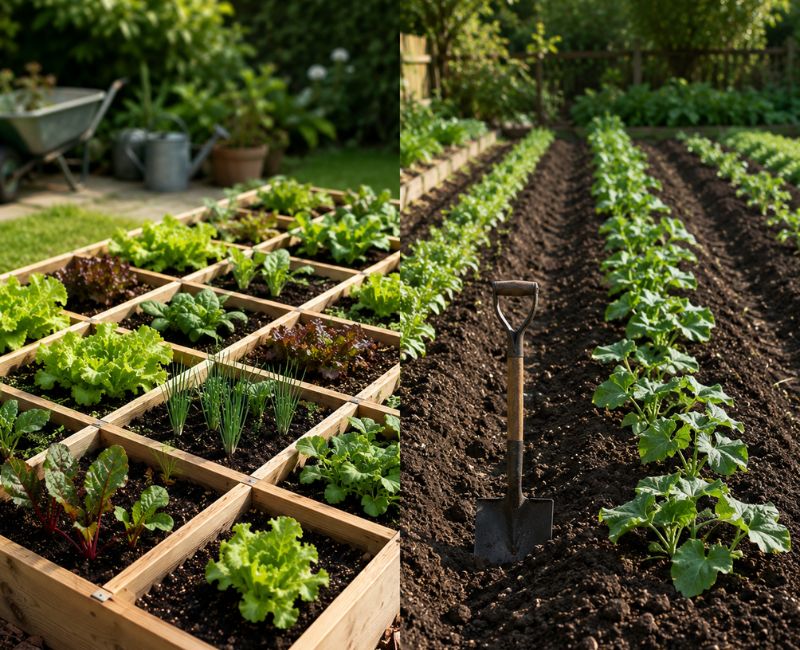
Walk into a traditional vegetable garden and you’ll see long parallel rows with wide pathways between them a system inherited from farming that made sense when tractors needed room to turn. Shrink that down to a backyard plot and you’re suddenly spending most of your time maintaining pathways you’ll never use.
Square Foot Gardening (SFG) challenges this assumption. Developed by Mel Bartholomew, it claims to reduce gardening effort by up to 50% while producing equivalent or better yields from a fraction of the space. That’s a bold claim. In this article, we put it to the test — comparing effort, yield, water use, cost, and suitability so you can decide which method is right for your garden in 2026.
What Is the Core Difference Between the Two Methods?
Traditional row gardening plants crops in long single or double rows with 18–36 inch pathways between each row. The wide spacing was originally designed for mechanical cultivation. In a home garden, it means most of your prepared soil sits under footpaths, not plants.
Square Foot Gardening divides a raised bed (typically 4×4 or 4×8 feet) into a grid of 1-foot squares. Each square holds a specific number of plants based on size 16 radishes, 4 lettuces, or 1 tomato. There are no pathways within the bed. Every inch of soil grows food.
This single structural difference how space is allocated drives most of the practical differences between the two systems.
Does Square Foot Gardening Really Reduce Work by 50%?
The 50% figure comes from Mel Bartholomew’s own research and the experiences of thousands of practitioners. Here’s where the time savings actually come from:
Weeding
In row gardening, the bare soil between rows is prime real estate for weeds. Weeding a traditional plot can take 2–4 hours per week during peak growing season.
In an SFG bed, dense planting creates a living mulch leaves shade the soil, suppressing weed germination. Most SFG growers report weeding for less than 5 minutes per session. Over a season, this is where the largest time saving accumulates.
Verdict: SFG wins significantly. The dense canopy is a practical, proven weed suppressor.
Watering
Row gardens require watering large areas including pathways. A 20×20 ft traditional plot might need 50–80 gallons per watering cycle.
An SFG bed of equivalent productive capacity requires watering only the planting area typically 60–70% less surface area. Combined with Mel’s Mix soil (which retains moisture better than standard garden soil), watering frequency drops noticeably.
Verdict: SFG wins on water efficiency. Particularly important in drought-prone climates.
Soil Preparation
Row gardening typically involves tilling an entire plot each season a labour-intensive process that can take several hours and often requires tools or machinery.
SFG uses a permanent raised bed filled with Mel’s Mix. After the initial bed setup, you simply top-dress individual squares with compost between plantings. No tilling required.
Verdict: SFG wins after year one. Initial setup requires more investment, but ongoing maintenance is dramatically lower.
Harvesting and Access
In a wide row garden, harvesting requires walking between rows, crouching, and sometimes kneeling on bare soil.
An SFG bed is designed so every square is reachable from the side no stepping inside the bed. Access is clean, organised, and quick.
Verdict: SFG wins on accessibility, especially for older gardeners or those with mobility limitations.
Side-by-Side Comparison: Square Foot Gardening vs Row Gardening
| Factor | Square Foot Gardening | Traditional Row Garden | Winner |
|---|---|---|---|
| Space needed for same yield | 20% of row garden | 100% baseline | SFG |
| Weeding time per week | 5–10 minutes | 2–4 hours | SFG |
| Water use | Low (dense canopy, rich soil) | High (open soil, pathways) | SFG |
| Initial setup cost | Moderate–High (raised bed + Mel’s Mix) | Low (existing ground) | Row |
| Soil preparation ongoing | Minimal (compost top-dress only) | Annual tilling required | SFG |
| Yield per sq ft | High (intensive planting) | Low–Moderate | SFG |
| Learning curve | Low (grid makes it intuitive) | Low (familiar to most) | Tie |
| Scalability | Best for small plots | Better for large plots | Depends |
| Root crop depth | Limited (needs Top Hat box) | No depth restriction | Row |
| Pest/deer protection | Easier (contained bed, nets) | Harder (large open area) | SFG |
| Best for | Small spaces, beginners, urban | Rural, large harvests, farms | Depends |
Where Traditional Row Gardening Still Wins
SFG is not universally superior. Row gardening outperforms in specific scenarios:
Large-scale food production: If you’re growing enough produce to feed a family of five through winter, or selling at a farmers’ market, the SFG method doesn’t scale efficiently. Large row gardens are faster to plant with mechanical tools.
Vining crops: Pumpkins, watermelons, and winter squash need room to sprawl. Row gardens give them that freedom without complex trellising.
Deep root crops in heavy volumes: Parsnips, large carrots, and potatoes grown in bulk are more naturally suited to deep in-ground row beds (though the SFG “Top Hat” technique addresses this for smaller harvests see Top Hats for Root Crops).
Budget constraints: Building raised beds and filling them with Mel’s Mix has an upfront cost of $50–$200 depending on size and materials. If you have existing garden soil and basic tools, row gardening is near-free to start.
Which Method Is Right for You in 2026?
Ask yourself these three questions:
- How much space do you have? Less than 200 sq ft → SFG. More than 500 sq ft → Row may be more practical.
- How much time do you want to spend maintaining the garden? Minimal time → SFG clear winner.
- What are you growing? Salads, herbs, tomatoes, peppers, beans → SFG excels. Pumpkins, large squash, potatoes in bulk → Row or hybrid approach.
Many experienced growers use a hybrid method SFG beds for high-value crops (herbs, salads, tomatoes) alongside traditional rows for larger space-hungry vegetables. This is an increasingly popular approach in 2026 as food growing in smaller plots becomes the norm.
Read next: All-New Square Foot Gardening 4th Edition: What’s Changed in 2026? | Square Foot Garden Plans for Extreme Weather 2026
Conclusion
The evidence supports the 50% claim but with an important qualifier. Square Foot Gardening genuinely reduces effort for small-to-medium plots, particularly in weeding, watering, and soil preparation. The savings are real, measurable, and reported consistently across thousands of growers.
Where row gardening wins is scale, upfront cost, and large vining crops. For most home gardeners in 2026 working with limited space, SFG is the more efficient and more enjoyable method.
Want to dig deeper? Explore our Mel’s Mix Alternatives guide for sustainable soil options, or check out the full SFG 4th Edition breakdown to see what’s new for this growing season.