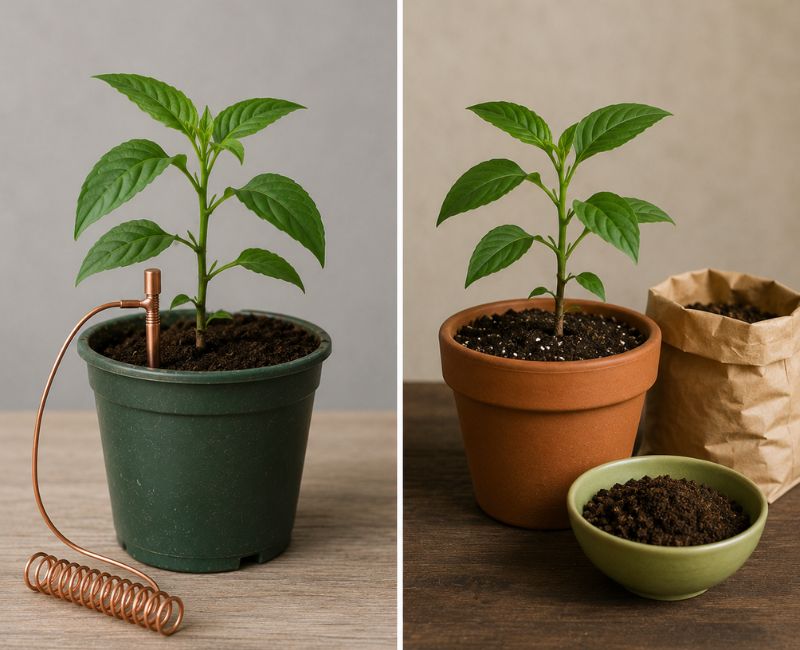
Here’s the question that matters: if you have limited time, money, and growing space, where should you put your effort?
Electroculture advocates argue that a $10 investment in copper wire can replace the need for fertiliser entirely boosting yields through atmospheric energy without any chemical or biological inputs. Organic fertiliser advocates argue that feeding your soil feeds your plants, and that evidence-based inputs produce reliable, repeatable results.
In 2026, both camps have vocal communities online. At Plantugaoo.com, we believe the fairest thing we can do for our community is compare these approaches head-to-head on evidence, cost, effort, results, and sustainability so you can make an informed decision for your own garden.
What We’re Comparing
This article compares two approaches to improving plant growth and yield in a home garden:
Electroculture: Passive copper wire installations (spiral stakes, horizontal antennas) claimed to collect atmospheric electricity and stimulate plant growth without physical inputs.
Organic fertilisers: A range of proven organic inputs including compost, worm castings, seaweed extract, fish emulsion, blood and bone meal, and green manures — all with established evidence bases and known mechanisms.
We assess each across seven dimensions: evidence quality, cost, effort, environmental impact, results reliability, scalability, and suitability for different garden types.
Evidence Quality
Electroculture
As covered in detail in our full electroculture science article and scientists’ critique, the specific claims of modern TikTok electroculture that copper wire antennas collect atmospheric electricity to boost yields have no peer-reviewed support. Laboratory research on controlled electrical stimulation of seeds is real science; passive antenna gardening is not the same thing.
Evidence rating: Very Low (for the specific antenna claims)
Organic Fertilisers
The evidence base for organic soil amendment and fertilisation is among the most robust in agricultural science:
- Compost: Decades of peer-reviewed research confirms compost improves soil structure, water retention, microbial diversity, and plant-available nutrition. A 2014 meta-analysis in Soil Biology and Biochemistry confirmed compost application increases crop yield across 37 independent studies.
- Worm castings: Peer-reviewed research (e.g., Atiyeh et al., 2000 in Bioresource Technology) confirms worm castings improve seed germination, root growth, and yield in multiple crops.
- Seaweed extract: Multiple studies confirm seaweed-based biostimulants improve stress tolerance, root development, and yield recognised by the EU as a legitimate biostimulant category in agricultural regulation.
- Fish emulsion: Nitrogen and trace mineral source with extensive applied use; documented effectiveness in multiple crop production systems.
Evidence rating: Very High backed by decades of peer-reviewed, independently replicated research
Cost Comparison
For a Standard 4×8 Raised Bed (One Season)
| Input | Electroculture | Organic Fertiliser Route |
|---|---|---|
| Copper wire (one-time) | $8–15 | — |
| Wooden stakes (one-time) | $3–5 | — |
| Compost (top-dress, per season) | — | $10–20 |
| Worm castings (optional supplement) | — | $8–15 |
| Seaweed extract (liquid feed, 8 weeks) | — | $8–12 |
| Blood and bone meal (optional) | — | $5–10 |
| Total Year 1 | $11–20 | $26–57 |
| Total Year 2+ | $0 (reuse copper) | $18–42 (ongoing compost + feeds) |
Cost verdict: Electroculture is cheaper, particularly after year one. The copper wire investment is one-time. Organic fertilisers are a recurring cost, though home composting dramatically reduces this a gardener who produces their own compost reduces ongoing costs to near-zero for the compost component.
Effort and Time Investment
Electroculture
- Setup: 1–2 hours to build and install copper stakes for a 4×8 bed
- Ongoing: Zero passive system, no maintenance required
- Observation: Only if running a conscious trial
Organic Fertilisers
- Compost: If buying ready-made, application takes 30 minutes per season. If home composting, 5–10 minutes per week of management plus the initial bin setup.
- Liquid feeds (seaweed, fish emulsion): 10–15 minutes every 2 weeks during growing season
- Blood and bone: Single application at planting, 20 minutes
Effort verdict: Electroculture requires less ongoing effort. Organic fertilisation requires modest regular investment but remains manageable for most home gardeners. The liquid feeding routine is actually beneficial it creates regular, close observation of your plants, which itself improves results.
Environmental Impact
Electroculture
- Copper mining has significant environmental impact tailings, habitat disruption, heavy energy use
- Copper wire is reusable and extremely long-lasting the environmental cost is front-loaded
- No chemical runoff, no packaging waste
- Copper accumulation in soil over many years is a documented environmental concern (see our copper wire in trees article)
Organic Fertilisers
- Compost (home-made): Lowest environmental impact of any garden input diverts organic waste from landfill, builds soil carbon, requires no manufacturing
- Worm castings: Similarly low impact if home-vermicomposted; modest if purchased
- Seaweed extract: Low-impact if harvested sustainably; some commercial products use over-harvested seaweed sources
- Blood and bone / fish emulsion: Byproducts of food processing moderate impact, significantly lower than synthetic alternatives
Environmental verdict: Home compost is the clear environmental winner in this comparison. Purchased organic fertilisers are generally lower impact than copper mining, but the comparison between copper wire (reused indefinitely) and packaged fertiliser (replaced annually) is genuinely close. Making your own compost dominates both.
Results Reliability
Electroculture
As reviewed in our experiments article, results from electroculture installations are highly variable and not attributable to the copper wire treatment in any properly controlled study. Some gardeners report improvements; others report none. The variability cannot currently be predicted or explained by any proposed electroculture mechanism.
Results reliability: Low high variability, no controlled evidence, results not distinguishable from noise
Organic Fertilisers
Results from organic fertilisation are highly reliable and well-predicted by established plant nutrition science:
- Nitrogen-rich inputs (blood meal, fish emulsion, worm castings) produce visible growth response within 1–2 weeks
- Compost top-dressing improves long-term soil health across seasons
- Seaweed extract improves stress tolerance and root development particularly valuable in drought or heat conditions
- Outcomes are consistent across different growers, different gardens, different seasons
Results reliability: Very High predictable, reproducible, consistent with established plant physiology
What Each Is Best For
| Criterion | Electroculture | Organic Fertilisers | Winner |
|---|---|---|---|
| Evidence base | None for antenna claims | Decades of peer-reviewed research | Organic |
| Upfront cost | $11–20 one-time | $26–57 Year 1 | Electroculture |
| Ongoing cost | $0 (reuse) | $18–42 per season | Electroculture |
| Effort | Near-zero (passive) | Low–Moderate (regular feeds) | Electroculture |
| Results reliability | Very Low | Very High | Organic |
| Environmental impact | Moderate (copper mining) | Low–Very Low (especially home compost) | Organic |
| Scalability (large garden) | Low additional cost | Higher ongoing cost | Electroculture |
| Nutrient-deficient soil fix | Not reliable | Reliable and specific | Organic |
| Soil health improvement | No evidence | Well-documented | Organic |
| Risk of harm (soil/plants) | Low–Moderate (copper buildup) | Very Low (when properly applied) | Organic |
The Honest Verdict
If your goal is reliable improvement of plant growth and yield, organic fertilisation led by home-made compost is the clear winner. The evidence is overwhelming, the mechanisms are understood, the results are predictable, and the environmental impact is low.
If your goal is minimum ongoing cost and effort and you accept low certainty of results, electroculture is inexpensive to set up and requires no maintenance. It may do nothing, but it’s unlikely to cause significant harm at modest scales.
The false dichotomy many online discussions create you’re either a fertiliser person or an electroculture person doesn’t reflect how most good gardeners actually operate. The most sensible approach is:
- Build your soil with compost this is the single highest-return investment in any garden
- Supplement with organic liquid feeds during peak growing season
- Experiment with electroculture if you’re curious but treat it as an add-on, not a replacement, and run proper controls
The gardeners who produce the most impressive results consistently are the ones who feed their soil biology. No antenna changes that fundamental truth.
The Role of Home Composting: Your Unbeatable Foundation
Before spending money on any fertiliser or investing time in electroculture, if you’re not already composting, starting is the single most impactful thing you can do for your garden.
What compost does that nothing else matches:
- Feeds the entire soil food web (bacteria, fungi, nematodes, earthworms)
- Improves soil structure in both sandy and clay soils
- Provides slow-release nutrition across a full growing season
- Suppresses certain soil-borne pathogens
- Costs nothing if you have kitchen and garden waste
A 4×8 raised bed top-dressed with 2 inches of quality home compost each spring requires very little additional fertilisation for most crops. That’s the foundation on which every other technique including, if you choose, electroculture experiments should be built.
Related: Mel’s Mix Alternatives: The Best Soil Foundations for Raised Beds | Square Foot Gardening vs Row Gardens: The Evidence | Electroculture Gardening: TikTok Trend or Science?
Conclusion
Electroculture and organic fertilisation are not equivalent alternatives they’re in fundamentally different categories. One has an extraordinary claim with no peer-reviewed evidence; the other has decades of consistent, reproducible, independent research support.
For Plantugaoo.com’s community, the conclusion is practical: invest in your soil biology through compost and organic inputs. These are the techniques that reliably produce better plants, healthier soil, and more sustainable gardens year after year.
If you want to add copper wire to your beds as well do it as a curious experiment alongside your evidence-based foundations, not instead of them. The best gardeners are always experimenting. The wisest ones make sure their experiments don’t come at the expense of what they know works.
Complete your Electroculture knowledge: Why Scientists Say Electroculture Has No Real Evidence | Electroculture Before/After Experiments | Copper Wire in Trees: What Really Happens.