
Whether you’re a sceptic who wants to test the claims properly or a curious gardener who simply wants to see what happens if you’re going to try electroculture, you might as well do it properly.
At Plantugaoo.com, we’re all for DIY experiments. Building things with your hands, testing ideas in your own garden, and seeing results for yourself is one of the best ways to learn. So this guide gives you exactly what you need to set up a basic electroculture system — the materials, the builds, the placement guidance, and the honest expectations framework that will help you actually evaluate what you find.
Read our full electroculture explainer first if you want the science background. This article is purely practical.
What You Need for a Basic Electroculture Setup
The modern electroculture toolkit is refreshingly simple and inexpensive. Most setups use three to five components:
| Material | Purpose | Where to Get It | Approximate Cost |
|---|---|---|---|
| Bare copper wire (18–24 AWG) | Conductor for antenna spirals | Hardware store, Amazon | $5–15 for 50ft |
| Wooden or bamboo stakes | Non-conductive base for spirals | Garden centre | $3–8 for pack of 10 |
| Copper sheet or pipe (optional) | Enhanced conductors for larger installations | Plumbing supplier | $5–20 |
| Wire cutters / pliers | Shaping and cutting wire | Any hardware store | Already owned |
| Ruler or dowel | Consistent spiral winding guide | Any hardware store | Already owned |
Total setup cost for a 4×8 raised bed: $10–25 depending on wire quantity purchased.
No electricity supply required. No battery. No connection to mains power. The entire premise of the modern electroculture setup is passive collection of atmospheric electricity meaning you build the structures, place them in the soil, and they operate without any power input.
The Three Main Electroculture Configurations
Configuration 1 The Spiral Copper Stake (Most Common)
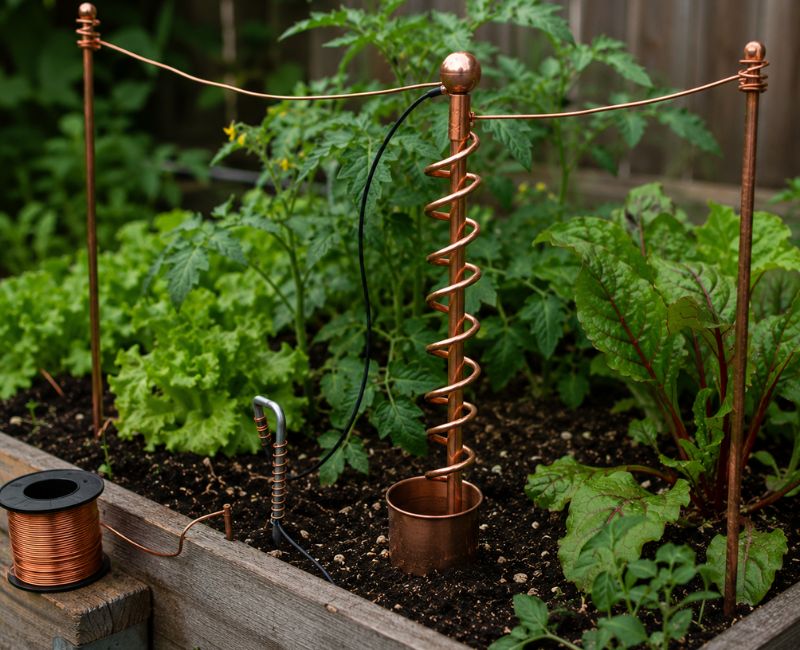
This is the signature electroculture installation a copper wire wound in a clockwise spiral around a wooden stake, inserted vertically into the soil near plants.
What advocates say it does: Acts as an antenna, collecting atmospheric electricity and channelling it downward through the stake into the soil and root zone.
Materials for one stake:
- 1× wooden dowel or bamboo stake (12–18 inches)
- 2–3 metres of bare copper wire (18 AWG)
- Wire cutters
Build steps:
Step 1 Prepare the stake Use a natural, untreated wood stake. Bamboo is ideal natural, sustainable, and non-conductive. Avoid metal stakes (they’ll interfere with the copper conductor concept) and treated wood (chemicals may leach into soil).
Step 2 Start the spiral Attach the wire to the bottom of the stake by wrapping it around twice and crimping tightly. This is your anchor point.
Step 3 Wind upward in a clockwise spiral Wrap the wire upward around the stake in a consistent clockwise spiral (when viewed from above). Space each wrap approximately 1–1.5 inches apart. Keep tension consistent throughout.
Electroculture advocates specifically emphasise clockwise winding. The reasoning given relates to alignment with the earth’s northern hemisphere rotation. No scientific basis exists for this directional preference — but if you’re following the method as described, clockwise is the convention.
Step 4 Finish at the top Continue the spiral to within 2 inches of the stake top. Secure the end by bending it into a small loop or wrapping it twice around the stake.
Step 5 Insert into soil Push the stake 4–6 inches into the soil near your target plant. The spiral should begin just at or slightly above soil level and extend upward.
Recommended placement: One stake per 1–2 square feet of bed area, positioned 4–6 inches from plant stems.
Configuration 2 — The Elevated Horizontal Antenna
This configuration places a horizontal copper wire above the bed at 12–24 inches height, running the length of the growing area. It’s described in Christofleau’s original 1927 work and represents the “atmospheric electricity collection” model more directly than the spiral stake.
Materials:
- 2× wooden posts (2–3 ft tall)
- 5–10 metres bare copper wire
- 2× insulators (ceramic or rubber any non-conductive material)
- Optional: copper ground rod for earthing the system
Build steps:
Step 1 Set posts Drive two wooden posts into the ground at opposite ends of your bed area. Space them to span the full length of the bed.
Step 2 Attach insulators Fix an insulator to the top of each post. These prevent the wire from making direct contact with the wooden post (though in practice this distinction matters more in theory than in a low-current passive system).
Step 3 Run wire Stretch bare copper wire horizontally between the two insulators, keeping it taut. At 12–24 inches above the plant canopy.
Step 4 Optional earthing Some electroculture practitioners attach a second wire running from one end of the horizontal antenna down to a copper rod driven into the soil, creating a ground connection. This more closely resembles a conventional lightning rod or earthing system.
Where this makes the most scientific sense: If electroculture has any plausible mechanism, this horizontal antenna configuration is more credibly an “atmospheric electricity” collector than a spiral stake it’s closer in design to an actual aerial antenna. Still no peer-reviewed evidence of crop benefit, but structurally more coherent.
Configuration 3 — The Spiral Cage
For container gardeners or individual large plants (tomatoes, peppers, squash), a spiral cage combines vertical support with the electroculture copper spiral concept.
Materials:
- Standard tomato cage or wire support
- Copper wire
- Wire cutters
Build: Wrap bare copper wire in a clockwise spiral around the outside of an existing tomato cage, from base to top. Insert cage around the plant as normal. The copper spiral integrates with the support structure.
Practical advantage beyond the electroculture claim: This configuration also serves as a functional plant support. Even if the electroculture effect is zero, the cage is still useful.
Placement Guidelines by Garden Type
| Garden Type | Recommended Configuration | Stakes/Antenna Count | Placement Notes |
|---|---|---|---|
| 4×4 raised bed | Spiral stakes | 4–6 stakes | One per 2–3 sq ft |
| 4×8 raised bed | Spiral stakes + horizontal antenna | 6–8 stakes + 1 antenna | Antenna runs length of bed |
| Container garden | Spiral cage per container | 1 per large container | Wrap support cage |
| In-ground row garden | Horizontal antenna + ground stakes | 1 antenna per row | Span full row length |
| Greenhouse | Horizontal antennas at roof height | 1–2 per growing section | Permanent installation |
How to Test Electroculture Properly
If you’re going to spend time building this setup, you might as well generate information that actually means something. A proper home trial takes minimal extra effort and produces results you can trust.
The Plantugaoo.com Home Trial Method:
Step 1 Choose identical plants Use the same variety of plant, ideally from the same seed packet or plug tray. Identical starting points are essential.
Step 2 Create two identical beds or sections Same soil mix, same sun exposure, same watering schedule. The only variable should be the copper wire installation.
Step 3 Install electroculture in one section only Add your copper spiral stakes or horizontal antenna to one section. Leave the other entirely untreated.
Step 4 Measure and document consistently
- Days to germination (if starting from seed)
- Height at weekly intervals
- Days to first flower
- Number of fruits or yield weight at harvest
- Photograph both sections on the same day each week
Step 5 — Record your findings Note everything — including weather events, any pest pressure, and anything you did differently even once. Share your results with the Plantugaoo.com community regardless of the outcome. Negative results are as valuable as positive ones.
What to Realistically Expect
We want to be straightforward with our community: based on current evidence, you are unlikely to see dramatic yield improvements from a copper wire installation.
What you might observe:
- No discernible difference (most likely outcome based on current evidence)
- Slight differences attributable to normal plant variation rather than copper wire
- A real improvement in which case, document it carefully and consider whether there’s an alternative explanation before attributing it to electroculture
What you should not expect:
- Doubled or tripled yields
- Elimination of pest pressure
- Reduced need for watering or feeding
If you’re trying electroculture because you want better plants, your time and money is almost certainly better spent on improved soil (see our Mel’s Mix guide), appropriate watering, and organic fertilisation. These methods have overwhelming scientific support and are the foundation of everything we recommend at Plantugaoo.com.
But if you’re curious, experimental, and enjoy building things the copper stake takes 20 minutes to make. Run the trial. See what happens. That’s exactly the kind of engaged, curious gardening we love to see in our community.
Related: Electroculture Gardening: Viral TikTok Trend or Scientific Scam? | Copper Wire in Trees: Does Electroculture Actually Increase Plant Growth? | Electroculture vs Organic Fertilizers: Cost, Claims & Reality Check 2026
Conclusion
Building a DIY electroculture setup is a genuinely enjoyable afternoon project inexpensive, simple, and satisfying in the way all hand-built garden additions are. The copper spiral stakes are attractive in their way, and the horizontal antenna adds a distinctive visual structure to any growing space.
Whether they improve your yields is a question the scientific community hasn’t answered conclusively at garden scale and the only way to find your own answer is to try it properly, with controls and measurements, in your own garden.
That’s the Plantugaoo.com approach to every gardening question: try it, measure it, share it. Your experience contributes to a community knowledge base that helps every other gardener who comes after you.
Explore the full Electroculture series: Electroculture Gardening: TikTok Trend or Science? | Copper Wire in Trees: Does It Increase Plant Growth? | Why Scientists Say Electroculture Has No Real Evidence.