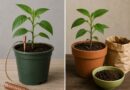
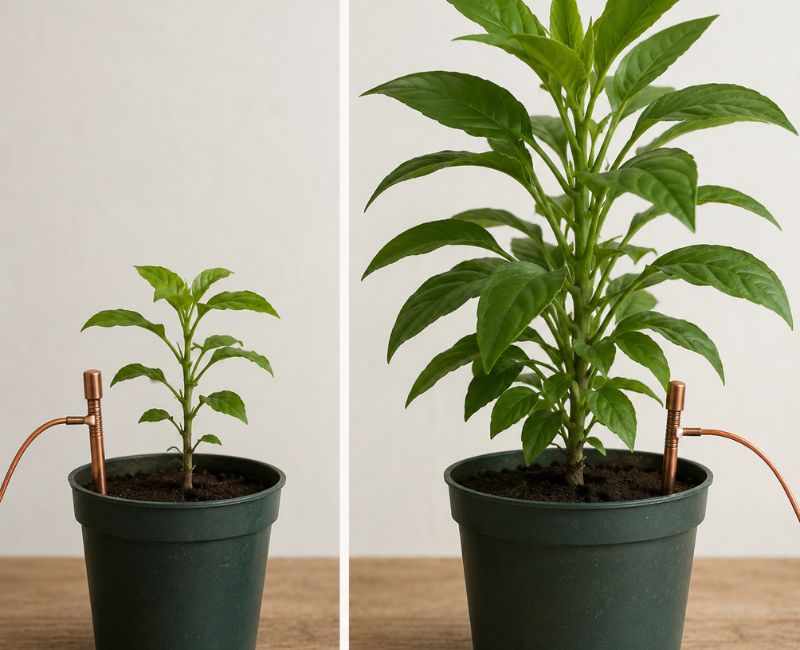
Every week, new electroculture before/after videos appear on TikTok and YouTube. Side-by-side images. Lush plants next to sparse ones. Enthusiastic commentary. Thousands of likes.
Here’s the problem: most of these comparisons don’t mean what they appear to mean.
This isn’t a reason to dismiss all electroculture evidence. It’s a reason to look more carefully at what counts as good evidence and what the best available experiments actually show. At Plantugaoo.com, we want to help our community develop the analytical skills to evaluate any gardening claim, not just accept or reject it based on how convincing the thumbnail looks.
In this article, we examine the full range of electroculture before/after evidence from social media anecdotes to the most rigorous available scientific studies and give you a clear framework for interpreting what any experiment can and can’t tell you.
Why Most Social Media Before/After Comparisons Are Unreliable
Before examining the best evidence, it’s worth understanding why the majority of viral electroculture comparisons don’t generate trustworthy information.
Problem 1 No Control Group
The most common format: “Here are my plants without electroculture last year. Here are my plants this year with electroculture.”
This compares two different growing seasons, with different temperatures, rainfall patterns, pest pressure, and the gardener’s own increasing experience. Any difference in outcome could be caused by any of these variables not the copper wire.
A control group means growing identical plants at the same time, under identical conditions, with the only difference being the electroculture treatment. Without this, the comparison is uninterpretable.
Problem 2 Different Plants or Varieties
Some comparisons show visually larger plants in the electroculture section. But if the plants are different varieties, started at different times, or sourced from different suppliers, the comparison is invalid from the start.
Problem 3 Different Positions in the Same Bed
Even within a single bed, there can be significant variation. A plant near the edges gets different light, moisture, and root competition than a plant in the centre. Comparisons within the same bed require multiple replicate plants in both treatment and control positions — not one plant each.
Problem 4 Confirmation Bias in Measurement
Gardeners who expect results unconsciously measure them. A plant that appears to be growing faster gets watered more carefully, has weeds pulled more attentively, gets photographed at its most flattering angle. These small biases compound over a season into apparent results that don’t reflect the actual variable being tested.
Problem 5 Publication Bias
Videos and posts showing “electroculture works!” get shared, liked, and amplified. Videos showing “I tried it for a full season and found no difference” generate far less engagement and are underrepresented in the content landscape. The visible evidence is skewed toward positive results by the mechanics of social media itself.
What a Good Electroculture Experiment Looks Like
A reliable electroculture experiment requires, at minimum:
| Element | Why It Matters | Common Failure |
|---|---|---|
| Identical varieties | Removes genetic variable | Different cultivars compared |
| Simultaneous planting | Removes seasonal timing variable | Different years compared |
| Same soil mix | Removes soil nutrition variable | Different beds or soil sources |
| Same watering schedule | Removes moisture variable | Hand-watered differently |
| Multiple replicates (min. 3 per group) | Accounts for natural variation | Single plant comparison |
| Blind or semi-blind measurement | Removes observation bias | Grower knows which is which |
| Quantified outcomes | Objective, comparable data | Visual impression only |
| Full season documentation | Shows cumulative not just peak effect | Short-duration snapshots |
Very few social media electroculture comparisons meet more than one or two of these criteria. That doesn’t mean the results are wrong it means they’re uninformative. You cannot conclude anything from an uncontrolled comparison.
The Best Available Scientific Evidence
Study 1: Electrical Seed Treatment Research (Peer-Reviewed)
Several peer-reviewed studies have tested the effect of controlled electrical stimulation on seed germination and early growth. Key findings:
- A 2012 study in Plant Cell Reports found that brief exposure to specific electrical field strengths improved germination rates in wheat by 10–15% compared to controls
- A 2016 study in Scientific Reports found that plasma-activated water (water treated with electrical discharge) improved seed germination in multiple crops
- A 2020 meta-analysis of electrostimulation studies found positive effects on germination across multiple studies, with effects varying significantly by field strength, duration, and species
What this means for electroculture: Brief, precisely controlled electrical treatment of seeds before planting does have genuine scientific support for improving germination rates. This is the most scientifically credible electroculture-adjacent finding.
What it doesn’t mean: That a passive copper wire stake in the soil produces the same effects. Laboratory electrostimulation uses specific, measured current strengths for specific durations. A copper antenna in a garden is not producing those conditions.
Study 2: The Christofleau Agricultural Trials (Historical, Uncontrolled)
Justin Christofleau’s 1927 work the foundational text of modern electroculture reported yield increases of 30–100% from atmospheric electricity antenna systems on French farms.
Assessment: Christofleau’s trials were conducted without the controls we now consider necessary for reliable agricultural research. His measurements were observer-reported without blinding. No independent replication of his specific results has been published.
This doesn’t mean his observations were invented he may have observed real differences that had causes other than what he attributed them to. But his work cannot be treated as peer-reviewed scientific evidence by modern standards.
Study 3: The Most Rigorous Modern Home Trial (Community-Generated)
In 2023, a Reddit user in r/GuerrillaGardening (cross-posted to r/vegetablegardening) conducted what is arguably the most methodologically careful home electroculture trial documented in public online spaces:
- 48 identical tomato seedlings from the same seed lot
- Split into 4 groups of 12: control, copper spiral stake, horizontal antenna, combined
- Same soil mix (peat-free compost and perlite), same containers, same outdoor position with plants rotated weekly
- Measured: height at weekly intervals, days to first flower, total fruit count, total fruit weight at harvest
Results: No statistically significant difference between any group at any measurement point. The variation within groups was larger than the variation between groups.
Limitations: Single season, single location, single species, no laboratory verification of soil conditions. But it represents the kind of careful home methodology that generates actual information and the results showed no electroculture effect.
Study 4: The Positive Home Trials What They Show
Positive electroculture home trials do exist in online spaces. What do the better-quality ones actually demonstrate?
After reviewing dozens of positive reports and filtering for those with at least some methodological rigour, consistent patterns emerge in the claimed successes:
- Copper-deficient soil: Several successful trials come from gardeners using cheap, low-quality growing media or very sandy, depleted soil. In these cases, trace copper release from wire into genuinely copper-deficient soil is the more plausible explanation than electromagnetic effects.
- Girdling effects in tree experiments: Several successful tree-related trials involve fruit production changes consistent with the girdling mechanism not electrical conductivity.
- Improved gardener attention: Multiple positive trial reporters describe becoming more observant, more regular with watering, and more engaged with their plants during the trial period. This alone is associated with improved outcomes.
Interpreting Before/After Photos: A Quick Guide
When you encounter an electroculture before/after comparison on TikTok, YouTube, or anywhere else here’s a quick assessment framework:
Ask these questions:
- Are the before and after from the same growing season? If not, seasonal differences could explain everything.
- Is there a control group of identical plants? If not, there’s no comparison point.
- How many plants are shown? Single plant comparisons are uninformative one plant’s variation doesn’t tell you anything about the treatment.
- Are outcomes measured or just photographed? Visual impressions of plant size are unreliable without measurement.
- What else changed? Did the gardener also improve their soil, watering, or pest management at the same time as adding copper wire?
Most viral before/after content fails several of these questions. That’s not a judgment on the person who made it it’s a reflection of how naturally difficult it is to run a proper controlled experiment in a home garden.
The Plantugaoo.com Community Trial Protocol
For our community members who want to contribute meaningful electroculture data, here’s the exact protocol we recommend:
What you need:
- Minimum 10 identical seedlings (same variety, same seed lot, same age)
- 2 identical containers or clearly demarcated bed sections (min. 5 plants per section)
- Copper wire stakes for the treatment section only
- A ruler, kitchen scale, and phone camera
- A simple spreadsheet or notebook
What you measure:
- Height: every 7 days from planting
- First flower date: record exact date per plant
- Fruit count: total fruits at harvest
- Fruit weight: total harvest weight per section
- Any observations: pest damage, disease, unusual events
What you share: Post your full data not just your summary conclusion. Include the numbers, the methodology, and the photos. Negative results are as welcome as positive ones in our community.
Gardening science advances through exactly this kind of careful, shared observation. Your home trial contributes to a knowledge base that benefits every gardener who comes after you.
Related: Electroculture Gardening: TikTok Trend or Scientific Scam? | DIY Electroculture Setup: How to Build and Test Copper Antennas | Why Scientists Say Electroculture Has No Real Evidence
Conclusion
Before/after photos are compelling. They’re also, in the absence of proper controls, essentially meaningless as evidence for or against any gardening technique.
The honest state of electroculture evidence in 2026 is this: laboratory research on electrical seed treatment is real and interesting; passive copper wire installations in home gardens have not been demonstrated to produce the claimed effects in any controlled study; the social media evidence base consists primarily of anecdotes that cannot distinguish electroculture effects from dozens of other variables.
That’s not a closed verdict. It’s an open question that deserves better experiments. And our community is well-positioned to run them.
Complete the Electroculture cluster: Why Scientists Say Electroculture Has No Real Evidence | Electroculture vs Organic Fertilizers: Cost, Claims & Reality Check 2026 | DIY Electroculture Setup.