
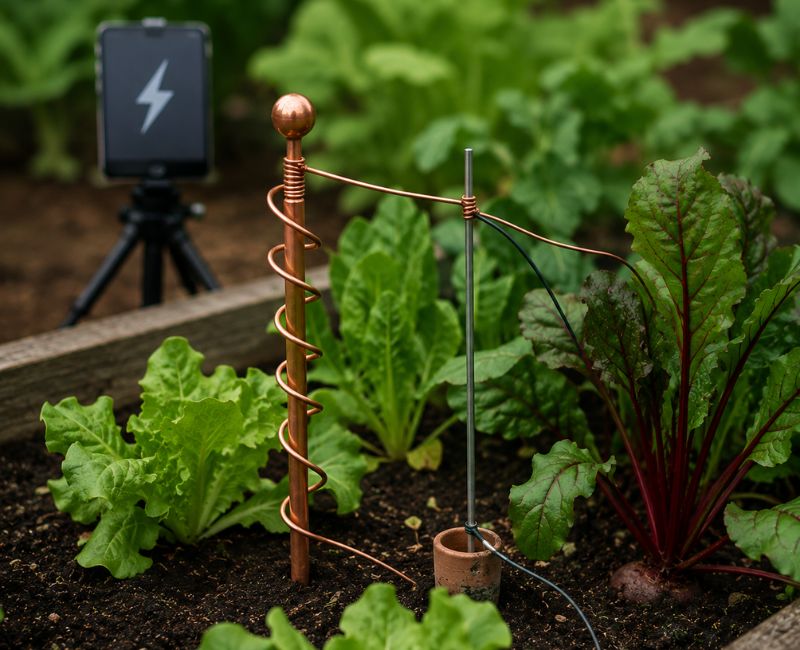
Scroll through gardening content on TikTok or YouTube in 2026 and you’ll find it everywhere: copper wire spirals twisted around wooden stakes, homemade antennas pushed into raised beds, claims of doubled yields and accelerated growth all attributed to something called electroculture.
Videos show before-and-after comparisons. Comment sections fill with enthusiastic testimonials. The hashtag has millions of views. And the products — copper wire kits, electroculture antennas, “atmospheric energy” garden tools are selling briskly on platforms from Etsy to Amazon.
But here at Plantugaoo.com, we believe you deserve honest information, not hype. So we went looking for the science behind the claims and what we found is more complicated, and more interesting, than either the enthusiasts or the debunkers typically acknowledge.
What Is Electroculture Gardening? (Definition)
Electroculture is the practice of using electrical currents, electromagnetic fields, or in its most popular modern form atmospheric electricity and metallic conductors to stimulate plant growth.
In its current TikTok incarnation, electroculture gardening typically involves:
- Winding copper wire in a spiral around a wooden or bamboo stake
- Inserting the stake into the soil near plants
- Claiming that the copper spiral acts as an “antenna” that captures atmospheric electricity or “cosmic energy” and channels it into the soil to stimulate plant growth
The practice is presented as ancient, chemical-free, and capable of increasing yields by 50–100% or more.
Where Did Electroculture Come From?
Electroculture is not a new idea. Its history stretches back over 200 years.
1700s–1800s: Early European scientists including Abbe Bertholon (France, 1783) and various Victorian-era researchers experimented with applying electrical currents directly to soil and plants. Some reported growth improvements; results were inconsistent and the mechanisms were poorly understood.
Early 20th century: More systematic research occurred in the 1920s–1940s, including work by the French agricultural researcher Justin Christofleau, whose 1927 book on electroculture described atmospheric electricity antennas very similar to what appears on TikTok today. Christofleau’s work is extensively cited in modern electroculture communities often uncritically.
Mid-20th century onward: The rise of synthetic fertilisers and industrial agriculture largely displaced interest in electroculture research. It remained a niche interest among alternative agriculture communities.
2020s: TikTok and YouTube gave electroculture a massive platform. Christofleau’s century-old concepts were rediscovered, stripped of their original scientific context, and presented as suppressed ancient wisdom. The modern electroculture movement was born.
What Do Electroculture Advocates Claim?
The claims made by electroculture proponents span a spectrum from the plausible to the extraordinary:
Moderate claims:
- Copper wire in soil improves plant health through trace copper mineral release
- Electromagnetic fields influence plant growth patterns
- Atmospheric electricity can be channelled to stimulate root development
Extraordinary claims:
- Copper spiral antennas double or triple crop yields with no other inputs
- Electroculture eliminates the need for fertiliser entirely
- Plants grown with electroculture are immune to pest pressure
- Atmospheric energy collected by antennas meaningfully powers plant growth
The language used: Modern electroculture content frequently uses terms like “cosmic energy,” “earth’s electromagnetic field,” “orgone energy,” and “vibrational frequency” language borrowed from alternative wellness rather than agricultural science. This is a significant signal when evaluating credibility.
What Does the Science Actually Say?
This is where the picture becomes genuinely nuanced. The honest answer is: some electroculture-adjacent research exists and shows real effects at controlled laboratory scales; the specific claims of the modern TikTok movement are largely unsubstantiated.
What Research Does Support
Electrostimulation of seeds: Multiple peer-reviewed studies have shown that brief, controlled electrical treatment of seeds before planting can improve germination rates and early seedling vigour. A 2012 study in the journal Plant Cell Reports documented improved germination in wheat seeds treated with specific electrical fields. This is real, reproducible science but it involves precise laboratory-controlled electrical treatment, not a copper spiral in the ground.
Copper as a soil amendment: Copper is a genuine micronutrient required by plants in trace quantities. In copper-deficient soils, adding copper does improve plant health. However, in normal garden soil, copper deficiency is rare, and excess copper is toxic to plants and soil microbiota. The trace mineral release from a copper wire is unlikely to be either significant or reliably beneficial.
Electromagnetic field effects on plant growth: Laboratory research has documented that strong, precisely controlled electromagnetic fields can influence plant growth. The earth’s natural electromagnetic field is approximately 50 microteslas orders of magnitude weaker than the fields used in laboratory experiments showing effects. A copper antenna in a garden interacts with this field at intensities that have not been shown to produce meaningful agricultural effects.
What Research Does Not Support
- There is no peer-reviewed evidence that copper spiral antennas placed in garden soil improve crop yields at any reliably measurable scale
- There is no mechanism by which atmospheric electricity could be “collected” by a copper stake in a way that produces the claimed yield improvements
- The “before/after” videos that constitute most electroculture evidence are uncontrolled anecdotes they don’t account for soil differences, watering, light, variety, season, or any of the many variables that determine plant growth
The scientific consensus: The specific claims of modern electroculture gardening that copper spiral antennas in soil significantly improve yields are not supported by published, peer-reviewed research. The broader history of electrostimulation research shows real but narrow effects under controlled conditions that do not translate to the garden-scale claims being made on social media.
Why Do People Report Results?
If electroculture doesn’t have scientific support, why do so many people post videos showing apparently impressive results?
Several explanations account for most reported success:
1. Confirmation bias: People who buy into electroculture invest more attention, care, and observation in their plants. More attention to watering, weeding, and pest management produces better results regardless of the copper wire.
2. Uncontrolled comparisons: Most before/after videos compare different plants, different soil conditions, different watering regimes, or different seasons. Without proper controls, any difference in outcome is uninterpretable.
3. The placebo effect applied to gardening: Humans are exceptionally good at seeing what they expect to see. A gardener who believes their copper antenna works will interpret normal plant vigour as electroculture success.
4. Real copper micronutrient effects in specific soils: In genuinely copper-deficient soils (rare but possible), a copper amendment does produce real improvement. This real effect, in a small minority of cases, generates genuine testimonials that others then generalise.
5. Selection bias in content: Successful electroculture videos get shared; unsuccessful ones don’t. The result is an apparent landscape of success stories with invisible failure data.
Electroculture Claims vs Evidence: Quick Reference
| Claim | Scientific Evidence | Verdict |
|---|---|---|
| Electrical fields affect plant growth | Yes — in controlled lab conditions | Partially true, context-dependent |
| Copper is beneficial to plants | Yes — as trace mineral in deficient soil | Conditionally true |
| Copper spiral antennas improve yields | No peer-reviewed evidence | Not supported |
| Atmospheric electricity feeds plants | No mechanism or evidence | Not supported |
| Electroculture replaces fertiliser | No evidence | Not supported |
| Brief electrical seed treatment improves germination | Yes — in controlled studies | Supported in specific conditions |
| Modern electroculture practices are evidence-based | No — relies primarily on anecdote | Not supported |
Is Electroculture Worth Trying?
If you’re curious, a copper wire spiral costs almost nothing to make and poses no meaningful risk to your plants at the stake-in-soil scale. If you want to experiment, by all means do but design your experiment properly:
- Grow identical plants side by side under identical conditions
- Only add the copper stake to one set
- Measure actual outcomes: days to germination, final plant height, yield weight
- Keep notes and take photos at consistent intervals
That’s the only way to generate information that means something. And if you find a genuine effect in your garden document it, share it with controls and methodology, and contribute to the evidence base.
See the experiments: Electroculture Gardening Compared: Before/After Plant Growth Experiments | Why Scientists Say Electroculture Has No Real Evidence | Electroculture vs Organic Fertilizers: Cost, Claims & Reality Check 2026
Conclusion
Electroculture gardening is neither a miracle system nor a complete fabrication. It has a genuine historical lineage, touches on real science at the margins, and the core question can electrical and electromagnetic phenomena influence plant growth? is a legitimate research area with documented (if limited) positive findings in controlled conditions.
What it isn’t is a validated, evidence-based garden technique. The TikTok-era copper antenna claims are not backed by peer-reviewed research, and the social media evidence consists almost entirely of uncontrolled anecdotes.
At Plantugaoo.com, our guidance is simple: stay curious, test ideas in your own garden with proper comparisons, and don’t abandon proven sustainable methods good soil, appropriate watering, organic nutrition for unproven alternatives.
Want to dig deeper? Read DIY Electroculture Setup: Copper Wire, Antennas & Electrical Currents Explained to understand the practice from the inside and Why Scientists Say Electroculture Has No Real Evidence for the full scientific critique.