
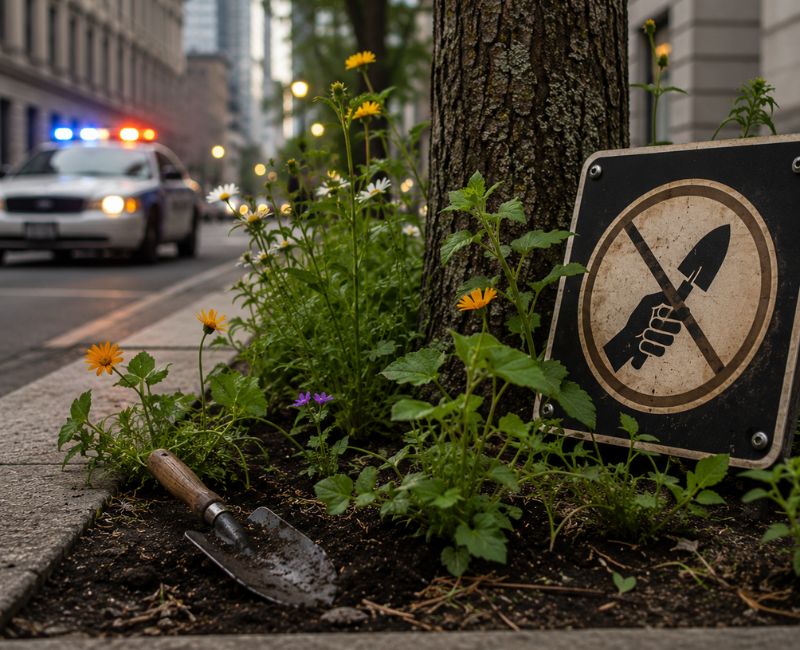
The short answer: it depends on where you’re planting, what you’re planting, and who owns the land but in most cases, the actual legal risk is low.
Guerrilla gardening exists in a legal grey zone in virtually every country. It is rarely explicitly illegal, almost never prosecuted as a criminal act, but technically constitutes trespass or interference with property in many jurisdictions. Understanding the legal landscape doesn’t require a law degree it requires knowing which questions to ask about any specific site.
This guide breaks down the legal position by country, the actual risk profile of different activities, and practical strategies for minimising legal exposure without abandoning the practice.
What Laws Actually Apply to Guerrilla Gardening?
Guerrilla gardening potentially engages several areas of law, depending on the activity and location:
Trespass
In most common law countries (UK, US, Australia, Canada), trespass is entering or remaining on land without the owner’s permission. Importantly, in England and Wales, simple trespass is a civil matter, not a criminal offence meaning the landowner can ask you to leave and potentially sue for damages, but police generally cannot arrest you for it unless a criminal trespass statute applies.
In Scotland, the right to roam legislation (Land Reform Act 2003) provides broader public access rights to land, making some guerrilla gardening activities even lower risk.
In the US, trespass laws vary by state but similarly distinguish between civil and criminal trespass criminal trespass generally requires a warning to leave that has been ignored, or entry through a locked barrier.
Criminal Damage
Planting in a way that damages existing structures, removes existing plants, or permanently alters a surface could constitute criminal damage. This is the higher-risk category:
- Lower risk: Planting in bare soil, dropping seed bombs, adding plants to a neglected space
- Higher risk: Removing existing (even ugly) plants, breaking surfaces, digging through tarmac or paving, attaching structures to buildings
The distinction is additive vs destructive intervention. Adding life to a neglected space rarely constitutes criminal damage in practice. Removing or breaking anything is a different matter.
Fly-Tipping and Littering
In the UK, depositing materials (including compost and plant material) on land without the owner’s consent can technically constitute fly-tipping under the Environmental Protection Act 1990. This is very rarely applied to guerrilla gardening but is a theoretical risk on private land.
Planning and Bylaw Restrictions
Some local authorities have specific bylaws about activities in parks, open spaces, or on the highway. These vary enormously by location and are rarely enforced against small-scale planting activities.
The Legal Position by Country
United Kingdom
Public land (council-owned verges, parks, open spaces): Planting on council-owned land without permission is technically interference with council property. In practice, councils vary enormously in their response — from active encouragement to occasional removal notices. Criminal prosecution is extremely rare and documented cases are essentially non-existent for basic planting activities.
The more likely outcome is one of three things: the planting is ignored (most common), a polite letter asking for removal is sent (occasional), or the council adopts the planting as its own (increasing, particularly for wildflower verges).
Highway verges (managed by Highways England or local highway authority): Technically requires permission. The Highways Act 1980 prohibits certain activities on the highway without consent. In practice, wildflower planting on verges is so widely practised and generally welcomed that enforcement action is almost unknown.
Private land: Civil trespass. The landowner can ask you to leave. If you refuse, they can seek a court order. In practice, guerrilla gardeners on private land who are approached simply leave and don’t return to that specific site.
Risk rating: Low for public land; Moderate for private land if you persist after being asked to leave.
United States
US law varies significantly by state and municipality, making generalisation difficult. However, some broad patterns apply:
Public land (city parks, road verges, medians): Most US cities technically require permits for any planting activity in public rights-of-way. Enforcement ranges from zero (most cities, most of the time) to active removal in areas with stricter maintenance regimes.
Notable positive precedent: Many US cities have introduced adopt-a-road-verge or community garden licence programmes specifically because guerrilla gardening demonstrated public demand for community green space management. Chicago, Portland, Seattle, and New York all have formal mechanisms for community groups to manage public green spaces.
Private land: Criminal trespass laws vary by state. Generally requires a warning to leave (posted or verbal) before criminal liability attaches. Simply entering and planting on abandoned private land without a warning sign is typically civil trespass only.
Risk rating: Low–Moderate depending on city and site; check local municipal codes for specific permit requirements.
Australia
Public land: State and local government land is generally managed by councils with varying attitudes to community planting. The ACT (Australian Capital Territory) has been notably progressive formal community garden programmes exist in many Canberra neighbourhoods. NSW and Victorian councils vary widely.
The Dividing Fences Act and related state legislation governs boundary and property matters but doesn’t specifically address guerrilla gardening.
Risk rating: Low in most jurisdictions for public land planting; check council bylaws for specific restrictions.
India
India’s legal framework regarding public land use is complex and highly variable by state and municipality.
The practical reality: Community-level improvement of shared public spaces has deep cultural precedent in India. In many urban neighbourhoods, informal planting of shared spaces is regarded as a community service rather than a transgression, and enforcement against it is essentially unknown.
Municipal Corporation jurisdiction: Most urban public land falls under Municipal Corporation management. These bodies vary significantly in their approach — some actively encourage community greening, others have specific prohibited activities that could technically apply to planting.
Risk rating: Very Low in practice; cultural context generally supportive.
Germany
Germany has relatively strong protections for communal use of urban spaces. The Kleingarten (allotment) tradition is deeply embedded in German culture, and community gardening enjoys widespread social and institutional support.
Temporary use urbanism — formalised through city-level agreements has become a recognised framework in Berlin and other German cities, legitimising many activities that would be guerrilla gardening elsewhere.
Risk rating: Low; Germany has some of the most community-garden-friendly legal frameworks in Europe.
Practical Risk Matrix for Guerrilla Gardening Activities
| Activity | Legal Category | UK Risk | US Risk | Practical Outcome |
|---|---|---|---|---|
| Seed bomb deployment on public verge | Civil/Possible bylaw | Very Low | Very Low | Ignored or welcomed |
| Planting wildflower plugs in tree pit | Civil trespass | Very Low | Low | Ignored or adopted |
| Planting in public park | Civil trespass/Bylaw | Low | Low–Moderate | Usually tolerated |
| Building raised bed on public land | Possible bylaw/planning | Moderate | Moderate | Removal possible |
| Attaching structures to buildings | Criminal damage risk | Moderate–High | Moderate–High | Removal + possible charge |
| Planting on private neglected land | Civil trespass | Low–Moderate | Low–Moderate | Asked to leave |
| Removing existing plants | Criminal damage | High | High | Potential prosecution |
| Digging through paved surface | Criminal damage | High | High | Potential prosecution |
Key takeaway: The highest-risk activities all involve destruction or permanent structural change. Adding plants to bare soil sits at the lowest end of the risk spectrum in virtually every jurisdiction.
How to Reduce Your Legal Risk Without Stopping
1. Target public land over private land. Public land carries civil risk at most; private land can escalate to criminal trespass more quickly.
2. Add, never remove. Never pull out existing plants, break surfaces, or remove council-installed infrastructure. Additive intervention is dramatically lower risk than destructive intervention.
3. Choose low-surveillance sites. Sites covered by CCTV near entrances to private land carry higher identification risk. Road verges and public parks are lower.
4. Consider asking. For more substantial projects, a quick email to the local council asking about their stance on community verge planting is often met with tacit approval or even formal encouragement. Many councils have adopted informal “no objection” policies for wildflower planting.
5. Know your exit. If approached and asked to stop, stop. The legal risk from a single planting session is minimal. The risk from confrontation or refusal to leave is higher.
6. Document your work. Photographs of neglected before-states and transformed after-states are useful if you’re ever challenged they demonstrate community benefit and the condition of the site before intervention.
Has Anyone Actually Been Prosecuted for Guerrilla Gardening?
Documented criminal prosecutions specifically for guerrilla gardening activities (planting, seed bombing, basic cultivation) are extraordinarily rare. Searches of UK and US legal databases produce essentially no cases of successful prosecution purely for planting plants on neglected public land.
The cases that have attracted police attention have generally involved:
- Significant structural changes to property
- Repeat activity after formal warnings to desist
- Activities in high-security areas (near government buildings, airports)
- Activities coupled with other offences (trespass on private land combined with refusal to leave after warning)
For the vast majority of guerrilla gardening planting flowers in neglected public spaces prosecution is a theoretical risk with an extremely low practical probability.
Explore the movement: Guerrilla Gardening Explained: Seed Bombs & the Urban Movement | Guerrilla Gardening for Urban Revitalization | Late-Night Secret Plantings: How Groups Organise
Conclusion
Guerrilla gardening occupies a genuinely ambiguous legal position — technically outside the rules in most jurisdictions, practically tolerated or welcomed in almost all circumstances where the activity involves adding plants to neglected public space without causing damage.
The legal risk is real but small. The cultural and political trend is moving toward legitimisation rather than enforcement. And the documented history of the movement is a story of grassroots action repeatedly proving what institutions were too cautious or under-resourced to attempt themselves.
Plant thoughtfully, document your work, be ready to have a conversation, and choose your sites with care. The flowers will almost certainly outlast any legal concern.
Complete the Guerrilla Gardening cluster: 10 Creative Guerrilla Gardening Innovations | Corporate Guerrilla Gardening Campaigns | Guerrilla Gardening for Urban Revitalization.