At 2am on a Tuesday, a group of people dressed in dark clothing crouch beside a neglected traffic island in South London. They’re not up to anything illegal at least not in any way most people would care about. They’re planting sunflowers.
This is guerrilla gardening: the act of cultivating land you don’t own or have official permission to use, typically to reclaim neglected or derelict urban spaces for nature, community, and beauty.
It sounds niche. It isn’t. Guerrilla gardening is now a global movement with thousands of active practitioners across every major city on earth and its most famous tool, the seed bomb, has become one of the most recognisable symbols of grassroots urban environmentalism.
What Is Guerrilla Gardening? (Definition)
Guerrilla gardening is the practice of planting, cultivating, or improving land without the landowner’s permission, most commonly in urban public or semi-public spaces road verges, roundabouts, abandoned lots, pavement cracks, and neglected parks.
The motivations vary:
- Political activism: Reclaiming public space from neglect and corporate indifference
- Environmental: Increasing urban biodiversity, pollinator habitat, and green cover
- Community: Creating beauty and green space in underserved neighbourhoods
- Practical: Growing food in cities where garden space is scarce or unaffordable
Guerrilla gardeners operate across a spectrum from the fully clandestine (night-time plantings, anonymous groups) to the semi-official (community campaigns with tacit council approval) to the fully public (daytime events with media coverage).
Where Did Guerrilla Gardening Begin?
The modern guerrilla gardening movement has two key origin points, separated by decades.
New York, 1973: A group called the Green Guerrillas began transforming derelict lots in the Lower East Side of Manhattan into community gardens. At the time, New York was financially bankrupt, crime-ridden, and had abandoned large swathes of inner-city land. The Green Guerrillas threw clay-and-seed “green grenades” the original seed bombs over fences into vacant lots, kickstarting what would become one of the most significant urban greening movements in US history.
London, 2004: Richard Reynolds, a copywriter living in Elephant and Castle, began tending the neglected flower beds outside his council block and documenting it on a blog. His site guerrillagardening.org became the hub of a global community. Reynolds’ book On Guerrilla Gardening (2008) brought the movement to mainstream attention and remains a foundational text.
Between these two points, the term “guerrilla gardening” was coined by Liz Christy (one of the Green Guerrillas founders) and became the accepted name for the practice worldwide.
Today the movement has active chapters in Berlin, Mumbai, São Paulo, Tokyo, Sydney, and hundreds of cities between them.
What Is a Seed Bomb and How Does It Work?
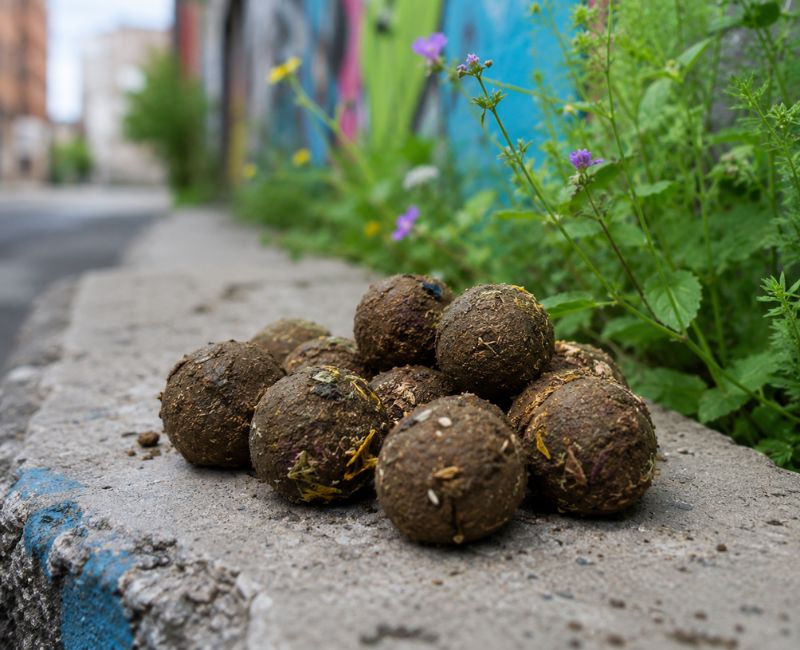
A seed bomb (also called a seed ball or earth ball) is a compact mixture of clay, compost, and seeds moulded into a ball and dried. The design serves several practical purposes:
Protection: The clay shell protects seeds from birds, ants, and wind until conditions are right for germination.
Moisture retention: Clay holds moisture, giving seeds a better chance of germinating in dry urban soil.
Ease of deployment: A seed bomb can be thrown over a fence, tossed into a gap in a wall, or dropped into a crack in pavement no digging required.
Delayed activation: Seed bombs don’t germinate immediately. The clay shell breaks down gradually with rain and moisture, releasing seeds when soil temperature and moisture are appropriate.
Basic Seed Bomb Recipe
Ingredients (makes ~20 seed bombs):
- 1 part seeds (wildflower mix, pollinator-friendly annuals)
- 3 parts dry red clay powder
- 5 parts dry compost
- Water (added slowly until mixture holds together)
Method:
- Combine dry clay and compost, then add seeds and mix thoroughly
- Add water a little at a time until the mixture is pliable but not sticky
- Roll into balls roughly the size of a large marble
- Dry completely (24–48 hours) before use or storage
- Store in a cool, dry place for up to 12 months
Best seeds for guerrilla gardening:
- Wildflower mixes (low maintenance, high visual impact)
- Poppies (self-seeding, drought-tolerant)
- Sunflowers (fast, visible, crowd-pleasing)
- Cornflowers (pollinator magnets, low water)
- Borage (edible, self-seeds prolifically)
- Native wildflowers for your region (most beneficial for local wildlife)
How Do Guerrilla Gardeners Organise?
The organisational structure of guerrilla gardening is deliberately loose by necessity. Formal organisation creates paper trails and membership lists that could expose participants to liability.
Digital communities: Most coordination happens through social media groups, Discord servers, and platforms like Reddit’s r/GuerrillaGardening. Actions are typically announced to trusted members only, close to the date.
Code language: Regular participants develop shorthand. “Night ops” refers to clandestine planting events. A “dig” is a daytime, semi-public planting session. “Seeds” might refer to participants as much as actual seeds in some communities.
Solo practitioners: Many guerrilla gardeners operate alone tending a verge on their daily walk, dropping seed bombs from a pocket, or quietly planting spring bulbs along a road they travel regularly. No group required.
Community events: In cities with active scenes, guerrilla gardening events can attract dozens of participants and operate openly, particularly when targeting genuinely neglected public land with low enforcement risk.
Related: Late-Night Sneak Outs: How Guerrilla Gardeners Organise Secret Plantings | Is Guerrilla Gardening Legal? Global Laws & Risks for Urban Planters
What Spaces Do Guerrilla Gardeners Target?
Not every patch of neglected land is equal. Experienced guerrilla gardeners choose their sites strategically:
| Space Type | Visibility | Legal Risk | Maintenance Ease | Best For |
|---|---|---|---|---|
| Road verges / traffic islands | High | Low–Moderate | Low (rain-fed) | Wildflowers, bulbs |
| Abandoned lots | Moderate | Moderate | Moderate | Larger plantings |
| Pavement tree pits | High | Low | Low | Hardy plants, bulbs |
| Council planter boxes | High | Very Low | Low | Annuals, herbs |
| Derelict building surrounds | Low | Moderate–High | Low | Long-term projects |
| Community park edges | Moderate | Low | Moderate | Shrubs, perennials |
The lowest-risk and highest-impact targets for beginners are tree pits (the bare soil squares around street trees) and road verges — both are publicly visible, generally appreciated, and rarely enforced against.
The Impact of Guerrilla Gardening: Does It Actually Change Cities?
Evidence of guerrilla gardening’s impact ranges from the anecdotal to the documented.
New York’s community gardens: The Green Guerrillas movement directly created over 600 community gardens across New York City. Many were later legalised and are now managed by the city’s GreenThumb programme one of the most successful urban gardening initiatives in the world. These gardens didn’t exist before guerrilla gardeners threw seed grenades into vacant lots.
London road verges: Multiple UK councils including parts of London and Rotherham have formally adopted “no-mow” and wildflower verge policies partly in response to community pressure from guerrilla gardeners who proved the concept on neglected verges.
Biodiversity uplift: Research from multiple urban ecology studies confirms that even small patches of flowering plants in cities measurably increase pollinator populations bees, hoverflies, and butterflies. Wildflower seed bomb deployments in urban areas have documented impact on local insect diversity.
Community cohesion: The less measurable but frequently reported impact is social. Guerrilla gardens create talking points, shared stewardship, and visible evidence that individual action matters all of which have documented effects on community wellbeing.
See the transformation evidence: Guerrilla Gardening for Urban Revitalization: Before/After City Transformations
Getting Started: Your First Guerrilla Gardening Action
You don’t need a group, a manifesto, or a black hoodie. Here’s the simplest possible entry point:
- Identify a target: Walk your neighbourhood and note neglected tree pits, bare verges, or abandoned planters.
- Make seed bombs: Use the recipe above with a local wildflower mix appropriate to your climate.
- Choose your timing: Early spring (before last frost) or autumn (for spring-germinating seeds) give the best results.
- Deploy: Drop, place, or lightly press seed bombs into your target site. No digging necessary unless soil is severely compacted.
- Observe: Most guerrilla gardeners return to their sites weekly to note progress. Some add water in dry spells. Some do nothing and let nature manage.
- Document: Photographs before and after are the most powerful tool for inspiring others and demonstrating impact.
Explore more techniques: 10 Creative Guerrilla Gardening Innovations: Plantable Packaging to Seed Bombs
Conclusion
Guerrilla gardening began as an act of protest against urban neglect and became something bigger: a global, decentralised movement that has measurably changed the landscape of cities on every continent. Its most famous tool the seed bomb is elegantly simple, cheap to make, and genuinely effective when used thoughtfully.
Whether you throw a seed bomb over a fence tonight or spend a Sunday afternoon planting wildflowers in a neglected tree pit, you’re participating in a tradition with over 50 years of proven impact.
Ready to go deeper? Read our guide to 10 Creative Guerrilla Gardening Innovations and explore the legal landscape in Is Guerrilla Gardening Legal? Global Laws & Risks.