The original guerrilla gardening toolkit was simple: a handful of seeds, a trowel, and the cover of darkness. Fifty years later, the movement has spawned an entire ecosystem of creative techniques, materials, and technologies some born from individual ingenuity, others from commercial design, and a few from the intersection of art, activism, and ecology.
Here are ten of the most inventive guerrilla gardening innovations, from the time-tested to the genuinely new.
1. The Classic Seed Bomb
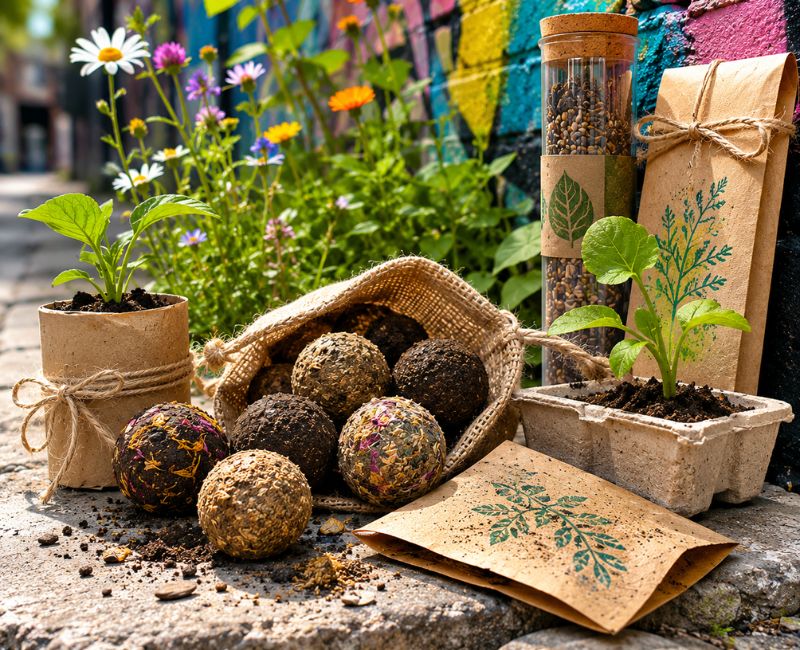
What it is: A compressed ball of clay, compost, and seeds the original guerrilla gardening tool, invented by the Green Guerrillas in New York in the 1970s.
How it works: The clay shell protects seeds from birds and desiccation until rainfall breaks it down, releasing seeds directly into whatever surface they land on. No digging, no tools, no visible activity.
Why it still matters: Seed bombs remain the most democratic guerrilla gardening tool. The materials cost pennies, the technique requires no skill, and they can be deployed from a distance over fences, into gaps, from passing vehicles. The basic design has barely changed because it doesn’t need to.
Best for: Road verges, abandoned lots, inaccessible sites, mass deployment events.
Full recipe and technique: Guerrilla Gardening Explained: How Seed Bombs Transform Urban Spaces
2. Seed Paper and Plantable Packaging
What it is: Paper embedded with seeds that germinates when planted or left in contact with moist soil. Can be manufactured as gift wrap, business cards, packaging inserts, envelopes, or bookmarks.
How it works: Seeds are incorporated into the paper pulp during manufacture. When the paper is shredded, torn, or buried and watered, the seeds germinate directly from the paper fibres.
The guerrilla gardening angle: Activists use seed paper as a stealth deployment tool leaving plantable bookmarks in library books, seed paper postcards in communal areas, or plantable flyers as public information that also green the environment. The act of littering becomes an act of planting.
Commercial evolution: Brands including Pangea Organics, Botanical PaperWorks, and numerous independent makers now produce seed paper at scale. It’s become one of the few guerrilla gardening innovations fully absorbed into mainstream commercial design.
Best for: Community outreach, mass distribution events, awareness campaigns, gift-giving with a green message.
3. Moss Graffiti (Eco Graffiti)
What it is: A living art form using moss, yogurt (or buttermilk), and water blended into a paintable paste that grows on walls, pavements, and stone surfaces.
How it works: The blended moss slurry is painted directly onto a damp surface. The yogurt provides nutrients for initial establishment. Over 4–8 weeks in humid conditions, the moss colonises the painted area and grows into a living green image or text.
Recipe:
- 1 clump of healthy moss (cleaned, dried)
- 200ml plain yogurt or buttermilk
- ½ tsp sugar
- Blend until smooth; apply with a paintbrush to porous outdoor surfaces
- Keep moist for the first 2–3 weeks
Controversy: Moss graffiti is legal in most jurisdictions where it’s applied to public surfaces (it’s not permanent damage, and moss is removable). On private property it carries the same legal risks as conventional graffiti.
Best for: Walls, bridges, stone steps, and any porous surface in a cool, humid location. Less effective in hot, dry climates where moss struggles to establish.
4. Yarn Bombing with Living Plants (Green Yarn Bombing)
What it is: An evolution of the fibre art form “yarn bombing” wrapping urban furniture in knitted or crocheted material that incorporates living plants, seeds, or growing moss into the textile itself.
How it works: Knitters and crocheters create textile pieces designed with pockets or loops that hold small plants, seed packets, or growing medium. These are attached to lamp posts, benches, railings, and fences as living installations.
The botanical version: Some practitioners sew seeds directly into wool or natural fibre panels as rain wets the fabric, seeds germinate and grow through the textile weave, creating a living tapestry.
Best for: High-visibility urban locations; community events; temporary installations that make a visual statement before being removed.
5. The Seed Grenade (Terracotta Version)
What it is: An upgrade on the classic seed bomb using a terracotta clay shell moulded into a grenade shape more durable for long-distance throwing, better at piercing compacted soil on impact.
How it works: Fired (not just air-dried) terracotta retains the seed payload more securely than unfired clay and shatters on hard impact, releasing seeds directly at the point of entry. The broken terracotta fragments act as drainage material in the soil around the seeds.
Design origin: Commercial versions were developed in Germany and Japan in the 2000s and have since become a popular item in independent garden shops worldwide. DIY versions require kiln access but perform significantly better than air-dried clay in dry conditions.
Best for: Throwing into compacted urban soil, rocky sites, or walled areas where precise seed placement matters.
6. Guerrilla Vertical Gardens
What it is: Unauthorized installation of wall-mounted planters, pallet gardens, or modular green wall systems on blank urban walls, building facades, or unused vertical surfaces.
How it works: Practitioners attach planting pockets fabric, plastic, or wooden to walls using screws, magnets (for metal surfaces), or adhesive fixings. These are planted with hardy, drought-tolerant species suited to vertical growing: sedums, ferns, ivy, native trailing plants.
Notable examples: Various cities including London, Melbourne, and Berlin have seen guerrilla vertical gardens installed overnight on blank walls some later legitimised by building owners, others removed within days.
Legality: This is one of the higher-risk guerrilla gardening activities as it involves physical modification of property. Best applied to surfaces you own, or undertaken in consultation with building owners.
Best for: Urban areas with blank walls and limited ground planting space; temporary art installations.
7. Seed Dispersal by Drone
What it is: Using consumer drones to drop seed bombs or scatter loose seeds over large inaccessible areas wasteland, brownfield sites, post-industrial land, steep urban embankments.
How it works: Modified drones carry payloads of seed bombs or biodegradable seed capsules and drop them over target areas using GPS-mapped flight paths. Originally developed for reforestation projects, the technology has been adapted by guerrilla gardeners for urban-scale deployment.
Commercial precedent: Companies including DroneSeed and BioCarbon Engineering have deployed drone seeding at scale for reforestation. Urban guerrilla gardeners have adapted smaller consumer drones for neighbourhood-scale wildflower seeding.
Regulatory note: Drone flights in urban areas are subject to local aviation regulations. In most countries, flights over populated areas require permits making this technique more practically available for rural and semi-urban fringe sites.
Best for: Large brownfield sites, river embankments, inaccessible slopes, post-construction bare soil areas.
8. Guerrilla Bulb Bombing
What it is: The large-scale, unsanctioned planting of spring-flowering bulbs daffodils, crocuses, tulips, alliums in public spaces during autumn, designed to produce a spectacular and unmissable display the following spring.
How it works: Groups of guerrilla gardeners plant hundreds or thousands of bulbs in a single night across road verges, parks, roundabouts, and public green spaces. The planting is indistinguishable from authorised municipal planting and the visual result in spring is often so well-received that councils choose to protect rather than remove the plants.
Why bulbs work so well: Bulbs are fast to plant (a bulb planter removes a plug of soil in seconds), low-cost in bulk, require no ongoing maintenance, and produce reliable year-after-year displays. The time lag between planting and flowering means the action is entirely anonymous.
Notable campaigns: The UK guerrilla bulb bombing movement, championed by groups inspired by Richard Reynolds’ work, has planted millions of bulbs in British cities. Several councils have since formally adopted the practice and invited guerrilla gardeners to lead official campaigns.
Best for: High-visibility public areas; community impact projects; beginner guerrilla gardeners (low risk, immediate gratification the following spring).
9. Plantable Street Art (Seed Stencils)
What it is: Using chalk stencils filled with wildflower seed mix rather than paint creating temporary street art that, over weeks, germinates into living plant shapes on the pavement or in soil.
How it works: A stencil is laid on bare soil or a cracked pavement surface. Wildflower seed mix is pressed firmly into the stencil area, adhered with a thin layer of biodegradable binder. The stencil is removed, leaving a seed-covered shape that germinates in rain.
On hard surfaces: On concrete or tarmac with surface cracks, seeds can be suspended in a biodegradable gel and squeezed into cracks through a stencil shape, germinating in pavement fissures.
Best for: Artistic communities, creative activism, high-footfall areas where the growing image can be observed developing over time.
10. Guerrilla Food Forests
What it is: The most ambitious guerrilla gardening scale transforming neglected urban land into permanent, multi-layer food forest systems with fruit trees, berry bushes, herbs, and ground-cover edibles.
How it works: Food forest design follows permaculture principles: tall fruit trees as canopy, smaller fruiting shrubs beneath, perennial herbs and edibles as ground cover. A well-established food forest requires minimal maintenance and produces food indefinitely.
Long-term guerrilla gardening: Food forests are the opposite of anonymous they take years to establish and require ongoing community stewardship. Successful urban food forests have been established in Seattle, London, Todmorden (UK), and numerous cities in Germany, typically beginning as guerrilla projects and later formalised with community or council support.
Incredible Edible Todmorden in Yorkshire, UK is the most famous example: a community project that began by planting edible plants in public spaces without permission and evolved into an internationally recognised model of community food production.
Best for: Committed community groups; long-term neighbourhood transformation; sites where land ownership is ambiguous or community use is established by practice.
Explore more: Guerrilla Gardening for Urban Revitalization: Before/After City Transformations | Is Guerrilla Gardening Legal? Global Laws & Risks | Corporate Guerrilla Gardening Campaigns: Adidas & Eco-Friendly Marketing
Comparison: Guerrilla Gardening Innovations at a Glance
| Innovation | Cost | Skill Level | Legal Risk | Impact Timescale | Best Climate |
|---|---|---|---|---|---|
| Classic seed bomb | Very Low | None | Low | Weeks | Temperate |
| Seed paper | Low | None | Very Low | Days | Any |
| Moss graffiti | Very Low | Low | Low–Moderate | Weeks | Cool/Humid |
| Yarn bombing (living) | Moderate | Moderate | Low | Days | Temperate |
| Terracotta seed grenade | Low–Moderate | Low | Low | Weeks | Any |
| Guerrilla vertical garden | Moderate | Moderate | Moderate–High | Immediate | Any |
| Seed dispersal by drone | High | High | Moderate | Weeks | Any |
| Bulb bombing | Low | None | Very Low | Months | Temperate |
| Plantable street art | Low | Low | Low | Weeks | Temperate |
| Guerrilla food forest | Variable | High | Moderate | Years | Any |
Conclusion
Guerrilla gardening has evolved far beyond the seed bomb. From plantable packaging and moss graffiti to drone-seeded wildflower fields and community food forests, the movement’s toolkit now spans every scale from a single cracked pavement to an entire neglected urban district.
The common thread is intent: transforming neglected space into something alive, useful, and beautiful — without waiting for permission that may never come.
Start with a seed bomb or a bag of autumn bulbs. Graduate to a vertical garden or a food forest over time. The entry point is wherever you are now.
Next in the Guerrilla Gardening series: Corporate Guerrilla Gardening Campaigns: Adidas & Eco-Friendly Marketing and Late-Night Sneak Outs: How Guerrilla Gardeners Organise Secret Plantings.