
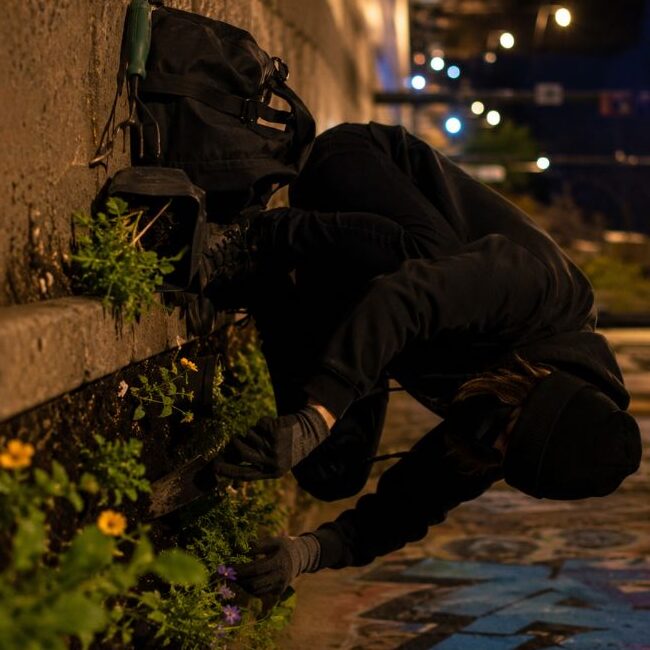
It’s 11:30pm on a Saturday in South London. Eight people meet at a bus stop. Nobody is wearing anything identifiable. One person carries a canvas bag that clinks. Another has a backpack stuffed with what looks like sod. A third is holding a thermos of tea.
Within 20 minutes, a traffic island that’s been bare concrete and litter for three years will have 200 wildflower plugs planted in it. Within 35 minutes, the group will have dispersed. By morning, no one will be able to prove anything happened except that the island now looks noticeably better.
This is a “night op.” And the people who run them are more organised than you might expect.
Why Do Guerrilla Gardeners Work at Night?
The nighttime isn’t just about avoiding detection though that’s part of it. There are several practical reasons experienced guerrilla gardeners prefer working after dark:
Reduced interference: Passers-by, curious neighbours, and municipal workers are largely absent between 10pm and 5am. The work can be done at a measured pace without explanations or confrontations.
Cooler temperatures: For planting, this matters. Transplanted plugs and fresh seedlings suffer less stress when planted in cool, humid night air than during the heat of a summer afternoon.
Rain window timing: Many guerrilla gardeners time night ops to coincide with forecast rain in the following 24–48 hours giving newly planted material the best chance of establishing without hand-watering.
The element of surprise: A neglected site that looks exactly the same at midnight and then transformed by morning creates a “did that really just happen?” effect in the neighbourhood. That visibility the sudden arrival of something green and alive generates more community attention and goodwill than a gradual daytime planting would.
The culture: There is, honestly, an element of the theatrical to it. The secrecy, the whispered communication, the satisfaction of transforming something quietly and leaving it’s part of what draws people to guerrilla gardening over conventional community planting.
How Are Night Operations Organised?
The organisational structure varies by community and scale, but most follow a recognisable pattern.
Step 1 Site Selection
Sites are scouted in advance usually during daylight, on foot or by bicycle. The ideal target has several characteristics:
- Clearly neglected (no evidence of recent maintenance)
- Accessible without breaking any barrier (open verge, public pavement)
- Visible enough to be noticed but not so heavily surveilled that planting would be captured on CCTV
- Soil present (even if poor quality) planting into concrete is generally not feasible without significant preparation
Experienced organisers maintain a site list a running log of potential targets noted during normal daily movement. Most guerrilla gardeners have a mental map of every neglected tree pit, bare verge, and abandoned planter within a mile of their home.
Step 2 Plant and Material Sourcing
This happens in the days or weeks before the event. Sources include:
- Division from personal gardens: Many guerrilla gardeners deliberately grow surplus dividing hostas, campanulas, and hardy perennials specifically for deployment
- Seed-grown plugs: Grown from seed in small trays at home, raised to transplant size
- Rescued plants: Plants saved from skips, demolition sites, or over-stocked garden centres (staff are often sympathetic)
- Seed bombs: Made in bulk at home and stockpiled
- Purchased bulbs in autumn: Inexpensive in quantity; effective for mass deployment
Step 3 Communication and Assembly
This is where the culture becomes interesting. Experienced groups use several communication approaches:
Signal apps (encrypted messaging): Groups often use Signal or similar end-to-end encrypted messaging for coordination. Discussions about specific times, locations, and plans stay in these channels rather than public social media.
Code language: Over time, communities develop shorthand. “Night op” or “N.O.” for a clandestine planting event. “Dig” for a daytime semi-public event. A site might be referred to by a code name rather than its actual address in public channels.
Vague public announcements: In public-facing channels (Instagram, Reddit), invitations are deliberately vague: “We’re doing something in South London this Saturday night, message us to join.” Anyone genuinely interested makes contact through private channels.
Trust networks: New participants are typically introduced through existing members rather than open recruitment. Bringing someone you don’t know to a night op introduces risk — legal, practical, and social.
Step 4 The Night Op Itself
Pre-assembly checklist (common to most groups):
- Dark, unremarkable clothing (not necessarily black grey or navy is less conspicuous)
- Tools: hand trowel, bulb planter, fork (kept in bags until on site)
- Water: a small amount for settling transplants
- Plants or seed bombs
- Phone with torch (covered, not waved around)
- A casual explanation if approached: “Just doing a bit of late gardening” is usually sufficient
On-site protocol:
Most groups work quickly and quietly. A typical night op runs 20–45 minutes. Roles are sometimes divided one or two people planting while others act as look-outs or carry materials. In practice, the look-out function is less about watching for police and more about being the first to offer a casual, non-suspicious explanation to any curious member of the public.
The exit: Groups disperse rather than leaving together. Meeting the next day at a café to see photos is a common tradition.
Step 5 Documentation
Photographs are the currency of the guerrilla gardening community. Before-and-after shots are shared internally first, then after a delay to avoid immediate identification of the site posted to community channels.
Documentation serves multiple purposes:
- Internal reward and motivation
- Community inspiration (“look what’s possible”)
- Long-term record of transformation
- Advocacy evidence when sites are later threatened with removal
The Tools of a Guerrilla Gardener
| Tool | Purpose | Notes |
|---|---|---|
| Hand trowel | Planting plugs and bulbs | Compact, essential |
| Bulb planter | Fast, consistent depth for bulbs | Game-changer for mass planting |
| Fork (small) | Breaking compacted urban soil | Often more useful than trowel |
| Seed bombs | No-dig deployment | Pre-made in bulk |
| Head torch (red light mode) | Low-visibility illumination | Red light less visible from distance |
| Canvas bags | Transporting plants discreetly | Inconspicuous |
| Water bottle | Settling transplants | Small, only what’s needed |
| Phone | Torch, navigation, documentation | Screen brightness down |
The Culture and Community of Guerrilla Gardening
Night ops exist within a broader culture that shapes how guerrilla gardeners think about their work.
The rule of minimum necessary intervention: Most experienced practitioners prefer doing the smallest intervention that makes the biggest difference. A handful of bulbs in a tree pit, not a full landscape redesign. This keeps actions fast, low-risk, and sustainable.
The no-ownership principle: Guerrilla gardeners plant but don’t claim. The work is done for the space and the neighbourhood, not for credit. Many practitioners never tell their neighbours what they’ve been doing the transformation speaks for itself.
The return visit culture: Good guerrilla gardeners revisit their sites. They pull weeds, water during dry spells, add more plants. The “guerrilla” prefix doesn’t mean abandon-after-planting the most enduring transformations are maintained, quietly, by the same people who started them.
Online communities: Reddit’s r/GuerrillaGardening, Instagram hashtags (#guerrillagardening, #nightop), and local Facebook groups are where most community interaction happens. Richard Reynolds’ guerrillagardening.org remains an archive and reference point for the movement.
Daytime “Digs”: The Semi-Public Alternative
Not all guerrilla gardening is nocturnal. Daytime digs are semi-public events, sometimes openly announced on social media, that operate in a legal grey zone planting on public land without formal permission but without concealment either.
Daytime digs have different characteristics:
- Larger groups (20–50+ participants in active cities)
- Children and families often participate
- Local press sometimes invited or self-invited
- Less concern with secrecy, more focus on community event
- Often target more prominent public sites where visibility is the point
The relationship between night ops and daytime digs is complementary. Night ops transform smaller sites quickly. Daytime digs make a larger community statement and are more likely to generate local council goodwill or at least public sympathy.
Related: Guerrilla Gardening for Urban Revitalization: Before/After City Transformations | Is Guerrilla Gardening Legal? Global Laws & Risks | Guerrilla Gardening Explained: Seed Bombs & the Urban Movement
Conclusion
The late-night guerrilla gardening operation the quiet assembly, the quick work, the dispersal before dawn is the movement’s most theatrical expression. But it’s also, in practice, a straightforward community service performed by people who are tired of waiting for official action on neglected public land.
The organisation is looser than it looks from the outside, the risk is lower than the midnight aesthetic suggests, and the impact measured in transformed sites, returning pollinators, and neighbourhood conversations sparked by a sudden burst of wildflowers is consistently and genuinely real.
Explore the full impact: Guerrilla Gardening for Urban Revitalization | Is Guerrilla Gardening Legal? | 10 Creative Guerrilla Gardening Innovations.