
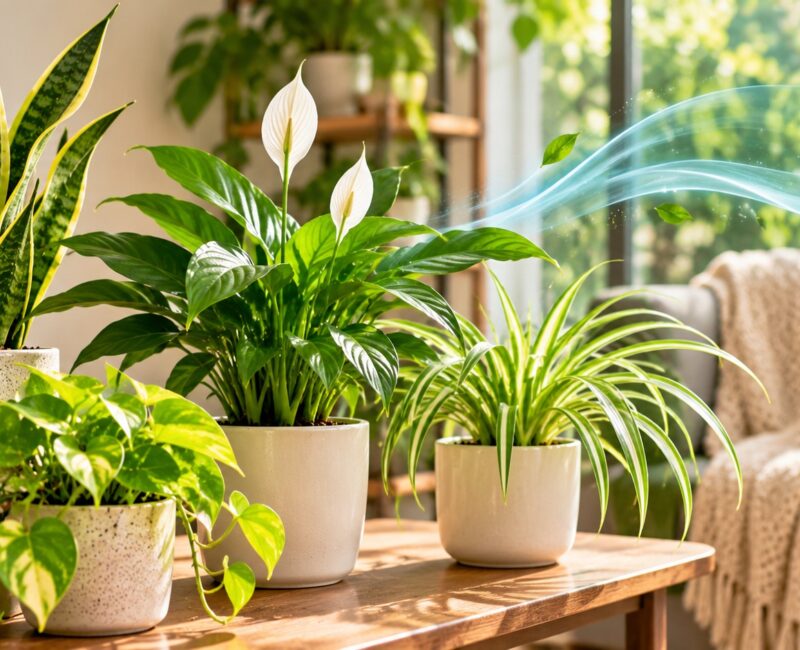
“Snake plants clean your air” and “peace lilies remove toxins” are among the most repeated houseplant claims, and the idea goes back to a NASA experiment from 1989. But do indoor plants purify the air in a normal home? The research says the effect is far too small to rely on. This article explains where the claim came from, what a review of 12 studies found, which claims are supported and which are not, and why you may still want plants in your home.
Quick Answer: Do Houseplants Really Clean the Air?
Not in a way that matters in a normal home. Plants removed pollutants in small sealed chambers in older studies, but a 2020 review of 12 studies found they remove them far more slowly than ordinary ventilation. Matching it would take roughly 10 to 1,000 plants per square metre of floor space. Keep plants for enjoyment, not air cleaning.
In This Guide
- Where the claim came from: the NASA study
- What the 2020 review found
- The claims, graded by evidence
- Why chamber results do not translate to homes
- A note for Indian homes and cities
- So should you still keep plants?
- Frequently asked questions
- Sources
Where the Claim Came From: The NASA Study
Iowa State University Extension explains that in 1989 NASA scientists reported that plants removed volatile organic compounds (VOCs), chemicals such as formaldehyde, benzene and trichloroethylene, from the air in sealed test chambers. Plants such as philodendron, peace lily and spider plant were later promoted as air purifiers based on this work.
Iowa State’s author notes the NASA study itself is not flawed; its controlled conditions just do not translate to real buildings. Drexel University researchers describe the setting as “a contained environment that has little in common with a house or office,” and say NASA was looking for ways to clean air on space stations.
What the 2020 Review Found
In 2020, Bryan Cummings and Michael Waring of Drexel University published a review in the Journal of Exposure Science and Environmental Epidemiology titled “Potted plants do not improve indoor air quality.” They reviewed 12 published chamber studies spanning about 30 years and converted 196 experimental results into a standard measure called the clean air delivery rate (CADR), which can be scaled to room size.
- Plants are very slow. The median single-plant CADR was 0.023 cubic metres per hour, and results varied across orders of magnitude.
- The plant count is unrealistic. To match the VOC removal from normal air exchange in a typical building (about one air change per hour), the abstract estimates it would take roughly 10 to 1,000 plants per square metre of floor space. (A university press release quoted 100 to 1,000; we use the journal abstract’s range.)
- Ventilation wins. The Drexel authors say natural or mechanical air exchange dilutes VOCs much faster than plants can remove them.
As researcher Michael Waring put it, “Plants are great, but they don’t actually clean indoor air quickly enough to have an effect.” Iowa State Extension quotes the US Environmental Protection Agency as saying there is currently no evidence that a reasonable number of houseplants remove significant pollutants in homes and offices, and says even one plant per square foot would not be enough.
The Claims, Graded by Evidence
We use the same categories as our other myth-checks. “Not supported” means the best evidence we found does not back it up, and “unknown” means our sources did not test it.
| Claim | Verdict | Why |
|---|---|---|
| Plants removed VOCs from sealed test chambers | Supported, but limited | The 2020 review covers 12 chamber studies, and many showed VOC reductions over time, which likely fed the popular belief (Drexel). The chambers are not like homes. |
| A few plants will clean the air in your room | Not supported | Median single-plant CADR of 0.023 m³/h; roughly 10–1,000 plants per m² needed to match normal ventilation. |
| Plants clean air “better than machines” | Not supported by our sources | The review compares plants with normal building ventilation, not with air purifiers, and we found no study showing plants outperform mechanical air cleaning. |
| Particular species such as snake plant or peace lily make a measurable difference at home | Not supported | Rates vary widely between plants, but the review’s overall conclusion is that the effect is too small to matter in real rooms. |
| Plants help with dust, smoke or PM2.5 | Unknown from our sources | The review is about VOCs, not particles. |
| Plants improve wellbeing or mood | Unknown from our sources | The Drexel authors suggest future research on wellbeing benefits; we do not claim a result. |
Why Chamber Results Do Not Translate to Homes
- Sealed, tiny spaces. Most earlier studies put a potted plant in a sealed chamber, often one cubic metre or smaller, injected a single VOC and tracked its decline over hours or days (Drexel).
- Real rooms exchange air. Iowa State Extension notes homes and offices have constant air turnover and new VOCs continually entering, so plants cannot remove them at that scale.
- The numbers do not scale. Even the favourable chamber results, converted to the same measure, fall orders of magnitude below normal ventilation.
A Note for Indian Homes and Cities
None of our sources look at Indian homes or at particulate pollution such as PM2.5, which is a major concern in many Indian cities. The review concerns VOCs only, so it cannot tell you whether plants help with dust or smoke. Ventilation is the review’s benchmark for removing VOCs, but opening windows is not always a good option when outdoor air is poor, and our sources do not address that trade-off. If air quality is a health concern for you or your family, rely on local air-quality guidance and medical advice instead of plants.
So Should You Still Keep Plants?
Yes, if you enjoy them. The Drexel researchers say plants can improve a room’s appearance, and Iowa State Extension encourages keeping houseplants for their beauty and for the enjoyment of gardening. That is a good reason by itself. Just do not treat them as air cleaners, and do not buy or crowd your home with plants for that purpose.
If you are choosing plants, pick them for their light and care needs. Our guide to non-toxic houseplants for busy people helps with pet and child safety, and our guide to why houseplants keep dying helps keep them alive.
Frequently Asked Questions
Did NASA prove that houseplants clean the air?
NASA’s 1989 work showed plants reduced VOCs in sealed test chambers. Iowa State Extension says the study is not flawed but its conditions do not translate to real buildings, and Drexel researchers describe the setting as having little in common with a house or office.
How many plants would I need to clean my room’s air?
The 2020 review’s abstract estimates roughly 10 to 1,000 plants per square metre of floor space to match the VOC removal of normal ventilation. Iowa State Extension says even one plant per square foot would not be enough.
Are snake plants or peace lilies good air purifiers?
They are popular choices, but we found no evidence that any single species measurably cleans the air in a normal home. They are good plants for other reasons, such as being forgiving to grow.
Do plants clean the air better than an air purifier?
Our sources do not show that. The review compares plants with ventilation, and we found no study showing plants outperform mechanical air cleaning.
Do indoor plants help with pollution in Indian cities?
Our sources do not say. The review is about VOCs, not PM2.5 or smoke, so we cannot claim a benefit. Check local air-quality guidance if pollution is a concern.
Conclusion
Indoor plants are lovely, but they are not air purifiers. A review of 12 studies found they remove VOCs far too slowly to compete with ordinary ventilation, and the famous NASA result came from small sealed chambers. Grow plants because they make your home nicer and because you enjoy caring for them, and treat any “cleans the air better than machines” claim with suspicion.
Sources
- Bryan E. Cummings and Michael S. Waring: Potted plants do not improve indoor air quality: a review and analysis of reported VOC removal efficiencies, Journal of Exposure Science & Environmental Epidemiology 30(2):253–261 (2020), DOI 10.1038/s41370-019-0175-9
- Drexel University News: Study: Actually, Potted Plants Don’t Improve Air Quality (6 November 2019)
- Aaron Steil, Iowa State University Extension and Outreach: Improving indoor air quality with houseplants (reviewed January 2024)