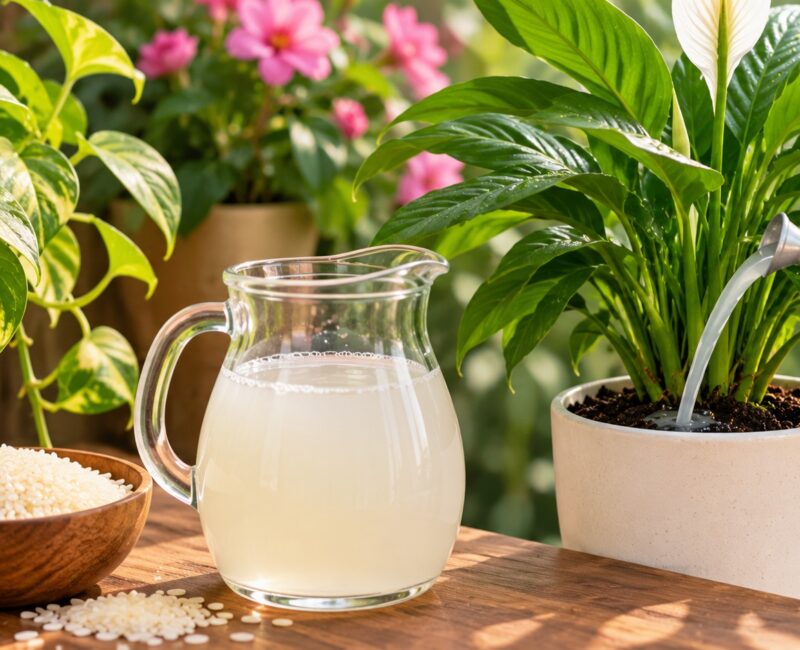
Chawal ka pani, the cloudy water left after washing or boiling rice, is one of the most popular “free fertiliser” tips in Indian gardening. Many people swear by it, and many videos promise greener leaves and faster growth. So does rice water for plants really work? The honest answer is “possibly, for some crops in soil, but nobody has shown it for your houseplants.” This article separates what the research shows from what is only anecdote, and tells you what to do instead.
Quick Answer: Is Rice Water Good for Plants?
Rice water contains some plant nutrients, and one peer-reviewed soil trial found fermented rice water improved the growth of choy sum, a leafy vegetable. But University of Maryland Extension says there is little research on home use, gives no safe rate, and notes that rice can carry arsenic. For houseplants and potted vegetables, the evidence is insufficient, so a labelled fertiliser is the safer choice.
In This Guide
- The claims, graded by evidence
- What the research actually found
- Why the studies do not prove it works in your pots
- Safety: arsenic and edible plants
- What to do instead, and what to do if you still want to try
- Frequently asked questions
- Sources
The Claims, Graded by Evidence
We grade each claim using the categories we use for all gardening myths: supported, preliminary, no evidence found, or unknown. “No evidence found” means we did not find any research in our sources, not that the claim has been disproved.
| Claim | Verdict | Why |
|---|---|---|
| Rice water contains some plant nutrients | Supported, but variable | A 2021 review reports nitrogen, phosphorus, potassium, calcium, magnesium and sulfur in washed rice water. Amounts vary with the rice and how it is washed. |
| Fermented rice water improved growth of choy sum in soil | Preliminary | One peer-reviewed trial (Agronomy, 2022) found it did, over three planting cycles. It is a single crop in field-type soils. |
| Rice water works on houseplants and potted vegetables | Unknown | The trial used real soil, not potting mix. University of Maryland Extension says the findings may not apply to houseplants and that it has no research on home use. |
| Rice water can replace fertiliser | Not supported | In the same trial, conventional NPK fertiliser performed comparably well. The 2021 review says few studies compare rice water with conventional fertiliser. |
| Rice water prevents pests, cures yellow leaves or treats disease | No evidence found | None of our sources test this. |
| Rice water is safe for any plant, including vegetables you eat | Unresolved | University of Maryland Extension warns that rice absorbs arsenic from soil and contamination varies widely. |
What the Research Actually Found
A 2022 field-type trial on choy sum
The strongest evidence we found is a study by Abba Nabayi and colleagues in the journal Agronomy (September 2022). The researchers grew choy sum (Brassica chinensis var. parachinensis) over three planting cycles in three soil types: sandy clay loam, clay and silt loam. They compared unfermented washed rice water, three-day fermented washed rice water, a conventional NPK fertiliser, and plain tap water.
According to the abstract, the fermented rice water gave significantly higher growth and yield than the other treatments, and NPK performed comparably well. Plants given NPK or fermented rice water also showed 21 to 42 per cent higher water productivity than the others. The abstract also reports a downside: both forms of rice water increased leaching of ammonium and nitrate compared with NPK and the control, which means more nitrogen washing out of the soil.
A 2021 review of earlier work
The same research group published a review in 2021 on washed rice water as a nutrient source. It reports that earlier studies found growth increases in vegetables such as water spinach, pak choy, lettuce, mustard, tomato and eggplant, and that more rice water generally gave more growth. But the authors also say few studies compare it with conventional fertiliser and that existing studies often lack depth, for example by not measuring soil or plant nutrient content before and after.
What an extension service says
In March 2024, the Home and Garden Information Center at University of Maryland Extension answered a gardener’s question about making rice water fertiliser. It acknowledged that a recent study showed some benefit in certain circumstances and that rice water can contain nutrients, but said few studies exist. It had no research on home use and could not give an application rate.
Why the Studies Do Not Prove It Works in Your Pots
- One main crop. The 2022 trial used choy sum. Results for a money plant, a rose or a tomato may differ.
- Soil, not potting mix. University of Maryland Extension points out that the study used real soil rather than soilless potting mix, so findings may not carry over to houseplants.
- Controlled preparation. The trial used a defined, fermented preparation. Home rice water varies with the rice, the washing method and the amount of water, so you cannot reproduce the trial’s conditions in your kitchen.
- Related authors. The review and the trial come from the same research group, so they are not fully independent confirmation. We did not find independent replications.
- Nitrogen loss. The trial found more nitrogen leaching with rice water than with NPK, which is a cost as well as a benefit.
Safety: Arsenic and Edible Plants
University of Maryland Extension notes that rice plants readily absorb heavy metals from soil, especially arsenic, and that contamination levels vary widely. We found no data on how much of this ends up in rice washing water or in plants watered with it, so the risk for vegetables you eat is unquantified. That is a good reason to be cautious on edible crops. The same extension service says using rice water on non-edible outdoor plants may be fine, but notes it has not been researched locally.
One practical point from general horticultural reasoning, not from our sources: do not use water in which rice was cooked with salt or oil, because salt can build up in pots and harm roots.
What to Do Instead, and What to Do If You Still Want to Try
If your plant is struggling
Fertiliser rarely fixes a plant that has a watering, light or root problem. Work out the cause first. Our guide to why houseplants keep dying is a good place to start, and feeding a plant with damaged roots can make things worse.
If you want to feed your plants
University of Maryland Extension suggests using a fertiliser with a known nutrient content and dosage instructions for indoor plants and for outdoor food plants. Follow the label, because we cannot give a safe universal rate.
If you still want to try rice water
- Try it on one ornamental plant, not on every pot, and keep an untreated plant for comparison.
- Skip edible crops, given the arsenic caution above.
- Note the date, how you prepared it and what you observe, so you can tell whether anything changed. One plant over a few weeks is an anecdote, not proof, and we would say so if we published it.
- No research-based home dilution, schedule or fermentation protocol exists in our sources, so treat any exact numbers you see online as unverified.
For other low-waste ideas that rely on better-established practices, see our guide to eco-friendly gardening hacks.
Frequently Asked Questions
Is rice water a good fertiliser for plants?
It contains some nutrients and showed benefits for choy sum in one soil trial, but evidence for houseplants and potted vegetables is lacking, and it is not shown to replace a balanced fertiliser.
How often should I water plants with rice water?
There is no research-based answer. University of Maryland Extension says it has no research on home use and cannot give an application rate. If you experiment, try one plant and watch it closely.
Is rice water safe for houseplants?
We found no study on houseplants. University of Maryland Extension says the existing study used soil rather than soilless potting mix, so its findings may not apply indoors.
Can I use rice water on vegetables I will eat?
We would be cautious. University of Maryland Extension warns that rice can absorb arsenic and that levels vary widely, and we found no data on how much reaches plants through rice water.
Does rice water cure yellow leaves or pests?
We found no research showing that. Yellow leaves have many possible causes, including overwatering, poor light and root damage, so identify the cause before adding anything.
Conclusion
Rice water is not a proven miracle, but it is not nonsense either. It contains nutrients, and one trial found a benefit for one leafy crop in soil. What is missing is evidence for houseplants, potted vegetables and home-made preparations. Until that exists, feed your plants with a labelled fertiliser, fix the underlying care problem first, and treat rice water as an experiment on a single ornamental plant rather than a replacement for proper feeding.
Sources
- Nabayi, Teh, Tan and Tan: Consecutive Application Effects of Washed Rice Water on Plant Growth, Soil Chemical Properties, Nutrient Leaching, and Soil Bacterial Population on Three Different Soil Textures over Three Planting Cycles, Agronomy 12(9):2220, September 2022 (DOI 10.3390/agronomy12092220)
- Abba, Teh, Tan and Tan: Wastewater from washed rice water as plant nutrient source: current understanding and knowledge gaps (Universiti Putra Malaysia Press, 2021)
- University of Maryland Extension, Home and Garden Information Center via Ask Extension: rice water fertilizer question (28 March 2024)