
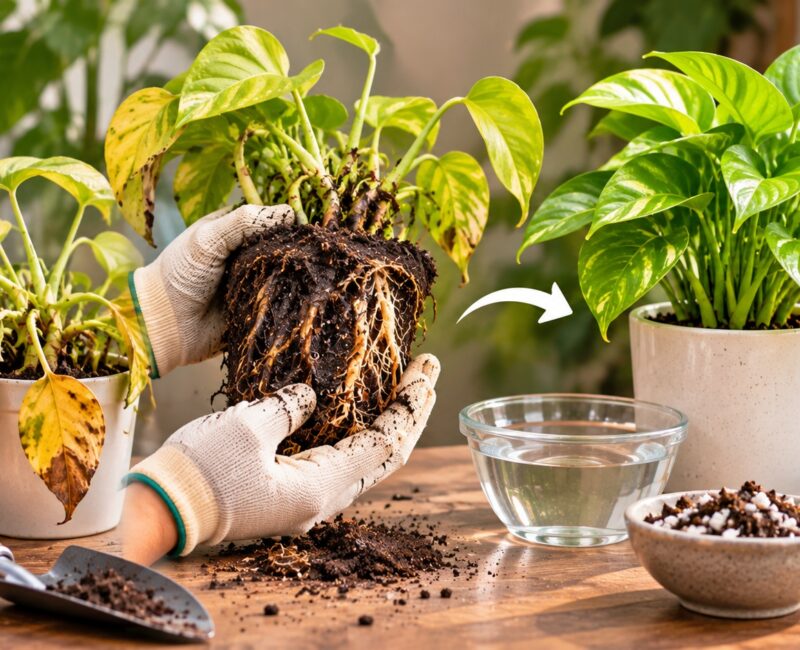
Root rot is one of the most common reasons a houseplant suddenly declines, and it is often mistaken for thirst. The leaves wilt, so you water more, and the problem gets worse. This guide explains what root rot is, how to confirm it by looking at the roots, how to try to rescue the plant step by step, and how to prevent it. It also says plainly when a plant may not be saveable, because no method guarantees recovery.
Quick Answer: How Do You Fix Root Rot in a Houseplant?
Stop watering, slide the plant out of its pot and check the roots. Healthy roots are firm and white; rotted roots are mushy and brown or reddish. Cut away the rotted roots with clean scissors, repot into fresh, well-draining mix in a clean pot with drainage holes, and water only when needed. If most of the roots are rotted, recovery is unlikely.
In This Guide
- What is root rot?
- Is it root rot? Signs above the soil
- How to confirm: check the roots
- How to rescue a plant with root rot
- What about fungicides?
- When the plant may not be saveable
- How to prevent root rot
- Root rot and India’s seasons
- Frequently asked questions
- Sources
What Is Root Rot?
Root rot is a plant disease in which roots decay. Iowa State University Extension names fungi and fungus-like organisms, including Pythium, Phytophthora, Rhizoctonia and Fusarium, as the causes, and says they thrive in wet, poorly drained soil and potting mix and infect stressed or weakened plants. University of Maryland Extension adds that excess water depletes oxygen in the soil and damages the fine roots, so the plant cannot absorb water.
That is why root rot is so often linked to overwatering. A plant can be sitting in wet soil and still wilt, because its damaged roots can no longer take the water up.
Is It Root Rot? Signs Above the Soil
Symptoms above the soil are not enough to be sure, because several problems look alike.
- Wilting lower leaves. Iowa State Extension says symptoms begin with wilting of the bottom leaves, which may progress upward to total collapse, and are often mistaken for lack of water.
- Yellowing lower and inner leaves. University of Maryland Extension lists wilting or yellowing of the lower and inner leaves as the main overwatering symptom.
- Drought-like damage. Continued excess water can cause scorch, leaf drop and eventually plant death, and University of Maryland Extension notes that overwatering looks much like root rot, crown rot and drought stress.
- Dark stem base. Clemson Cooperative Extension describes a ring of brown or black tissue at or near soil level on some infected stems.
Because these signs overlap with underwatering and other problems, always check the soil moisture and the roots before changing your watering. If your main symptom is yellowing, our guide to money plant yellow leaves shows how to tell the common causes apart.
How to Confirm: Check the Roots
Iowa State Extension advises examining the root system and checking the moisture of the potting mix before adding water. Tip the plant out of its pot carefully and look.
| What you see | What it suggests |
|---|---|
| Firm, white roots with many fine feeder roots | Healthy roots (Iowa State) |
| Mushy, brown or reddish roots | Rotted roots (Iowa State) |
| Brown to black, possibly soft roots | Infected roots (Clemson) |
| Soil is bone dry and roots look firm | Probably not root rot; consider underwatering (our inference from the root test above) |
To check moisture without unpotting, University of Maryland Extension suggests lifting the pot and comparing its weight with its weight after watering, or, for large containers, pushing a stick or dowel to the bottom. Moist soil clings to it or discolours it.
How to Rescue a Plant With Root Rot
Clemson Cooperative Extension says that if only a few roots are infected, you can cut them out and repot in sterile soil. These steps follow that approach. No source we read gives a recovery rate or timeline, so treat this as a best attempt, not a guaranteed cure.
- Stop watering. Do not give a wilting plant more water until you have checked the roots.
- Take the plant out of its pot and shake off the old mix so you can see the roots.
- Clean your tools. The University of Wisconsin plant disease clinic advises disinfesting tools with 70% alcohol, a disinfectant or bleach.
- Cut away the rotted roots. Remove mushy brown or reddish roots and keep the firm, white ones. Removing too much root at once can stress the plant, so be prepared for it to look sparse (general practice, not from our sources).
- Clean the pot. Clemson advises scrubbing reused pots and rinsing them in a solution of one part bleach to nine parts water. Always make sure the pot has drainage holes.
- Repot in fresh mix. Use new, well-draining potting mix. Clemson recommends sterilised or pasteurised soil, and the Wisconsin clinic recommends a soilless potting mix with adequate drainage. Do not reuse the old, wet mix. Choose a pot only slightly larger than the remaining root ball, because extra mix holds extra water (general practice).
- Water carefully afterwards. University of Maryland Extension says to water only when needed, which depends on the potting medium, pot material, humidity and temperature. Water thoroughly until water drains from the bottom, then empty the saucer.
- Be patient. Keep the plant in bright, indirect light (general practice, not from our sources) and wait for new growth before judging the result. We found no source giving a recovery time, so we cannot promise one.
If the plant is one that roots easily from stem cuttings, such as a money plant, you can also take a healthy cutting as a backup. See our guide on how to propagate a money plant.
What About Fungicides?
We do not recommend using fungicides on houseplants for this problem, and we do not give products or doses. Clemson Cooperative Extension says most indoor gardeners will find that fungicides cost more than a new plant. The Wisconsin clinic lists several active ingredients, marked as uncertain, and advises rotating them to limit resistance, which tells you how specialised the area is. If you choose to use any pesticide, follow the label for that plant and your country, and keep products away from children and pets.
When the Plant May Not Be Saveable
If nearly all the roots are mushy and the stem base is soft or black, the plant is unlikely to recover. Our sources do not set a cut-off, so this is a judgement call. In that case, look for any firm, green stem you can use for cuttings, and throw out the infected soil rather than reusing it. Wash your hands and tools afterwards.
How to Prevent Root Rot
- Use a well-drained mix and pots with drainage holes. Iowa State and the Wisconsin clinic both stress good drainage.
- Water by need, not by calendar. Iowa State says to water based on each plant’s needs rather than a fixed schedule. Use the lift-the-pot or dowel check from University of Maryland Extension.
- Empty saucers. University of Maryland Extension advises emptying saucers under pots, which also discourages fungus gnats.
- Keep plants vigorous. Iowa State recommends adequate, not excessive, water and good nutrition, and avoiding environmental extremes in winter.
- Buy healthy plants and clean pots. Clemson advises buying disease-free plants and scrubbing reused pots.
For broader troubleshooting, see our guide to why houseplants keep dying.
Root Rot and India’s Seasons
None of our sources address Indian conditions, so the following is inference. Soil stays wet longer when plants dry out slowly, which is common in cool weather and in humid monsoon months, so the same watering routine can become too much. Check the soil each time instead of keeping a summer schedule.
Frequently Asked Questions
Can a plant recover from root rot?
Sometimes. Clemson Cooperative Extension says that if only a few roots are infected, you can cut them out and repot in sterile soil. If most of the roots are rotted, recovery is unlikely, and no source we read gives a recovery rate.
What does root rot look like?
Iowa State Extension describes healthy roots as firm and white and rotted roots as mushy and brown or reddish. Above the soil, the bottom leaves often wilt or yellow first.
Does root rot smell?
None of our sources discuss smell, so we cannot say. Rely on how the roots look and feel.
Should I water a wilting plant?
Not before checking. Iowa State Extension says to examine the roots and the moisture of the mix before adding water, because root rot is often mistaken for lack of water.
Do I need to repot with fresh soil?
Yes. Clemson Cooperative Extension advises repotting in sterile or pasteurised soil, and the University of Wisconsin plant disease clinic advises a well-draining soilless mix. Reusing the old wet mix risks keeping the problem.
Conclusion
To save a plant with root rot, check the roots before you water, cut away the mushy brown ones with clean tools, and repot into fresh, well-draining mix in a clean pot with drainage holes. Then water only when the plant needs it. Be realistic about the outcome: a few damaged roots can often be managed, but a plant with mostly rotted roots may not recover, so take a backup cutting if you can.
Sources
- Erika Saalau, Iowa State University Extension and Outreach: Root Rots of Houseplants (14 February 2014; the page notes its information may not be the most current)
- University of Maryland Extension: Houseplant dieback (updated 13 March 2023)
- Clemson Cooperative Extension, Home and Garden Information Center: Houseplant Diseases and Disorders (updated 28 February 2025)
- Brian D. Hudelson, University of Wisconsin-Madison Plant Disease Diagnostics Clinic: Diseases of Houseplants (handout, undated)