Fresh dhania is one of the easiest herbs to want and one of the most annoying to keep alive, because it bolts (runs to flower) quickly once it gets hot. If you want to grow coriander in pots, the two things that matter most are when you sow and how you harvest. This guide covers the sowing seasons in the Indian sources we read, how to sow, how to keep leaves coming, how to slow bolting, and what we could not find a reliable answer for.
Quick Answer: How Do You Grow Coriander in Pots?
Sow seeds directly in a pot of free-draining mix, about 1.3 cm deep, in the cool season, because coriander bolts in heat. Seeds usually take about one to two weeks to germinate. Keep the mix evenly moist, sow a new batch every few weeks, and harvest a few leaves at a time once plants are 10–15 cm tall.
In This Guide
- When to sow coriander in India
- How to sow coriander seeds in a pot
- Light, water and mulch
- How to harvest so plants keep producing
- Why coriander bolts and what helps
- Pests and diseases
- What we could not confirm
- Frequently asked questions
- Sources
When to Sow Coriander in India
There is no single date for all of India, so treat the figures below as starting points and check what local growers and your state agricultural university recommend for your area. Here is what our sources say.
| Source | What it says | Note |
|---|---|---|
| Tamil Nadu Agricultural University (TNAU) Agritech Portal | Sowing seasons June–July and October–November; cool, comparatively dry, frost-free climate; does well at 20–25 °C | Field-crop guidance. The page does not say which regions the months apply to. |
| ICAR-Indian Institute of Spices Research (IISR), Coriander: Good Agricultural Practices (2019) | Sow early, when day temperatures fall below 25 °C; late sowing increases pest and disease incidence | Field-crop guidance. The document’s text is partly garbled, so we use only the clear statements. |
| Punjab Agricultural University (PAU), via our winter balcony vegetables guide | Mid-September to mid-October for north-west India | Specific to that region; see that guide for the table. |
The pattern is consistent: coriander wants cool weather. The Oregon State University Extension page agrees that seeds germinate at soil temperatures of about 13–20 °C (55–68 °F), and the RHS says plants bolt in hot, dry weather. Oregon State and the RHS are describing temperate climates, so we use them for how the plant behaves, not for Indian dates.
In practice, that means many Indian balconies suit autumn to early winter sowing, and the hottest months are the hardest. The June–July window in the TNAU page is for that source’s region and crop conditions; whether it works in a pot on your balcony depends on your local rain and heat.
How to Sow Coriander Seeds in a Pot
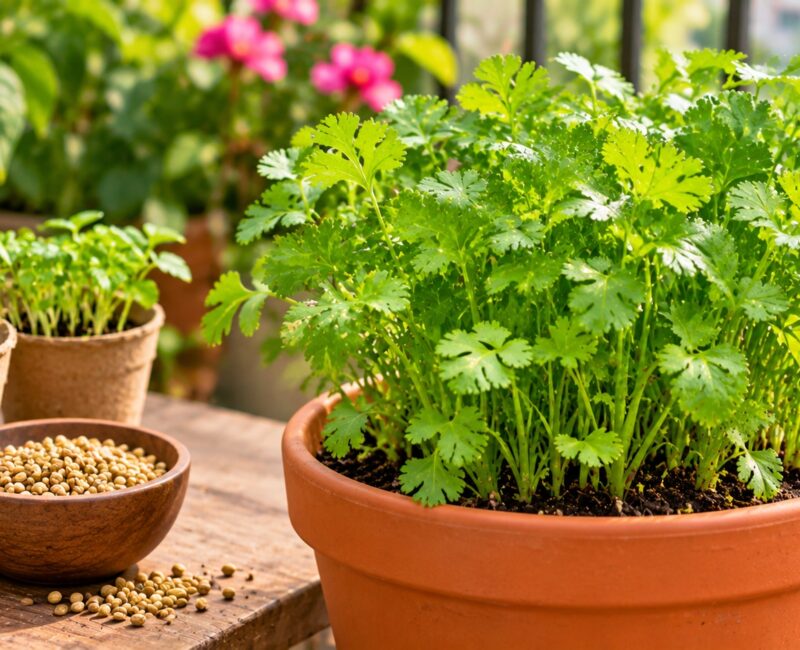
- Choose a pot with drainage holes. The RHS says coriander grows particularly well in containers and wants free-draining conditions. None of our sources give a pot depth. Because Oregon State notes a long taproot, we suggest choosing a deeper pot over a shallow tray (our suggestion, not a sourced measurement).
- Use a free-draining mix. The RHS recommends multi-purpose compost in pots. We give no Indian-specific potting mix recipe, because our sources do not.
- Split the seeds, and optionally soak them. The TNAU page says whole coriander seeds germinate poorly and are split before sowing, and it advises soaking seeds in water for 12 hours. Those are field-crop instructions, so treat them as a practical option for pots. Do not use the seed-treatment chemicals that page lists; they are for farm crops.
- Sow directly. Oregon State advises sowing seeds where they will grow, because the long taproot makes transplanting difficult, and covering them with about ½ inch (about 1.3 cm) of soil.
- Space the seeds. The RHS says to sow about 5 cm apart. For plants grown to seed it says to thin to 20 cm, which is larger than most pots allow, so seed production in a small pot is not realistic (our inference).
- Water gently and wait. The TNAU page gives about 8–15 days for germination. Oregon State gives no germination time.
Light, Water and Mulch
- Light. The RHS says full sun is best for seed crops, but for leaves in summer, use a cooler spot shaded from midday sun. Epic Gardening says leaves need 3 to 8 hours of direct sun a day. Epic Gardening is a commercial gardening site, so we use it for practical tips only.
- Water. The RHS says container plants dry out faster than plants in the ground, so check them daily and keep the compost just moist. It also says to avoid overwatering and to water in the early morning or evening. Epic Gardening suggests the soil should feel like a wrung-out sponge.
- Mulch. Epic Gardening suggests shading the soil, not the leaves, with an organic mulch such as compost, leaf mould or straw. This is a practical tip, not a tested result.
- Feeding. We found no pot-specific fertiliser guidance for coriander, so we give none. The TNAU fertiliser figures are per hectare for field crops and do not translate to pots.
How to Harvest So Plants Keep Producing
- Start when plants are 10–15 cm tall. The RHS says to take a few leaves from each plant and let them recover for about two weeks before the next harvest.
- Or cut back and let them regrow. Epic Gardening suggests letting seedlings reach 6 inches, then cutting back to 1 inch for regrowth. This is one commercial source’s technique; the RHS advises a gentler picking approach, so try both on separate pots.
- Harvest regularly. Epic Gardening says leaving plants unharvested signals them to bolt; we found no other source for that claim, so treat it as unconfirmed.
- Sow in batches. The RHS recommends sowing small batches every few weeks for leaves, and Epic Gardening suggests every 3 weeks. Oregon State agrees on small, repeated sowings.
- A mature-leaf note. The IISR document says up to 50% of leaves can be plucked at 75 days after sowing without reducing seed yield. That is a field-crop figure and we do not apply it to pots.
Why Coriander Bolts and What Helps
The RHS says coriander bolts in hot, dry weather. Oregon State says plants sown in mid-summer set seed within four to six weeks, and that warm weather shortens the life cycle. Cooler days give weeks or months of leaf growth before flowering.
| What people try | What our sources say |
|---|---|
| Sow in the cool season | Supported by TNAU, IISR, Oregon State and the RHS |
| Shade from midday sun | Supported by the RHS and Oregon State for leaf crops in warm weather |
| Keep soil evenly moist | The RHS says extra water in dry spells helps prevent bolting; Epic Gardening agrees |
| Cut off flower stems | The RHS says removing them as soon as they appear prolongs leaf harvests; Epic Gardening says it is not very effective because new stalks appear soon after. Sources disagree. |
| Sow again in succession | Supported by the RHS, Oregon State and Epic Gardening |
If a plant has bolted, you can let it flower and set seed. Oregon State and the RHS both describe harvesting seeds once they mature, which is the coriander spice. Note this takes the plant’s space for weeks.
Pests and Diseases
The IISR document says aphids can reduce yield by more than 50% in unprotected field crops from December to March, and it suggests yellow or blue sticky traps and conserving ladybird predators. The RHS advises protecting seedlings from slugs and snails. The TNAU and IISR pages also list powdery mildew, wilt and blight, with fungicide and pesticide recommendations for farms.
We do not give pesticide or fungicide doses for pots, because those recommendations are for field crops and we found no home-gardening dose guidance for coriander. If aphids appear, look at the underside of leaves and new growth, remove badly affected stems and check the product label of anything you consider using, especially for a plant you will eat (general practice, not from our sources). Wash leaves before use.
What We Could Not Confirm
- Exact pot size. No source we read gives a depth or diameter for coriander in containers.
- A universal Indian sowing calendar. The Indian sources give field-crop months for specific conditions, not balcony dates for every city.
- Yield per pot. We found no reliable figure, so we give none.
- Heat limits in pots. The IISR text on temperature thresholds is partly garbled, so we do not quote a numeric heat limit.
Frequently Asked Questions
How long does coriander take to grow in a pot?
The TNAU page gives about 8–15 days to germinate. It also says plants for leaf use are pulled at 30–40 days in field crops. The RHS says to start picking leaves when plants are 10–15 cm tall. We found no source giving a timeline specifically for pots.
Can I grow coriander from kitchen dhania seeds?
Our sources do not address seed bought for cooking versus seed sold for sowing. The TNAU page says whole seeds germinate poorly and are split before sowing, so crushing them lightly is reasonable, but we cannot promise germination from kitchen seed.
Can I grow coriander in summer in India?
It is the hardest season. The RHS and Oregon State say plants bolt in hot weather. If you try, use a shaded spot, keep the mix moist and expect a short harvest.
Why is my coriander flowering so early?
Heat is the usual reason in our sources. The RHS says it bolts in hot, dry weather, and Oregon State says mid-summer sowings set seed in four to six weeks.
Should I pinch off the flower stalks?
Sources disagree. The RHS says removing flower stems as soon as they appear prolongs leaf harvests, while Epic Gardening says new stalks appear quickly. It costs little to try, but sow a fresh batch regardless.
Conclusion
To grow coriander in pots, sow in the cool season, sow directly into a free-draining pot, keep the mix evenly moist, pick a few leaves at a time and sow again every few weeks. Expect bolting when it gets hot, and plan for it rather than fighting it. If you also grow other cool-season crops, see our guide to winter vegetables for balcony containers in India, and for more herbs and vegetables that suit small spaces, see our guide to growing edible plants on an apartment balcony.
Sources
- Tamil Nadu Agricultural University, Agritech Portal: Coriander
- ICAR-Indian Institute of Spices Research: Coriander: Good Agricultural Practices (September 2019)
- Ross Penhallegon and Jim Myers, Oregon State University Extension: How to grow cilantro for leaves, or coriander seeds
- Royal Horticultural Society: Coriander growing guide
- Jerad Bryant, Epic Gardening: 7 Tricks to Keep Your Cilantro Plants Thriving all Summer (June 2025; commercial source, practical tips only)