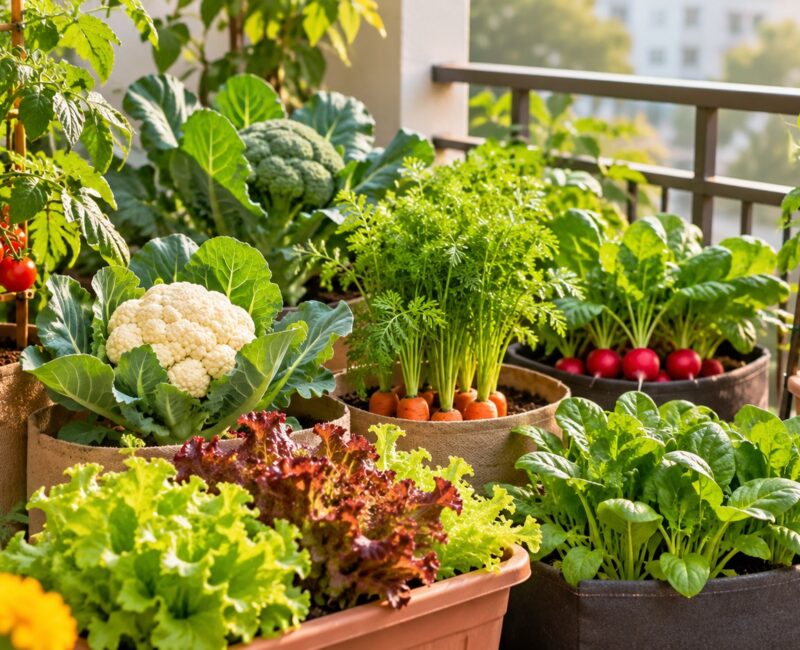
Winter is the best season for growing vegetables in pots across much of India, because leafy greens, roots and cole crops prefer cooler weather. The catch is that India has no single winter. A sowing date that suits Punjab in October can be wrong for Chennai or a frost-prone hill town. This guide shows which winter vegetables suit balcony containers, how big the pots need to be, and how to work out your own sowing window instead of copying a calendar written for somewhere else.
Quick Answer: What Winter Vegetables Can You Grow on a Balcony in India?
Spinach, methi (fenugreek), coriander, lettuce, radish, carrot, beetroot, turnip, peas and compact cabbage-family crops all suit winter containers in India. Use pots with drainage holes, give them at least four to six hours of sun, and sow within your region’s cool-season window. The sowing months below come from a Punjab source, so check your local agricultural university for your area.
In This Guide
- Before you start: sun, drainage and your region
- Winter vegetables for containers: crop, pot size and sowing window
- How big should the container be?
- What you can still sow in mid-November (north-west India)
- If you do not live in north-west India
- Watering, soil and feeding in winter
- Cold nights and frost
- Pests and problems
- Common mistakes
- Frequently asked questions
- Sources
Before You Start: Sun, Drainage and Your Region
Sunlight. University of Illinois Extension describes full sun as at least six hours a day and partial shade as four to six hours. Leafy crops cope better with partial shade than roots or fruiting vegetables do. Watch your balcony on a clear winter day and note how many hours of direct light each corner gets, because winter sun sits lower and a spot that was bright in summer may now be shaded by the building opposite.
Drainage. Every container needs drainage holes. Illinois Extension advises watering until water runs out of the bottom of the pot, which only works if the water has somewhere to go.
Your region. The only India-specific sowing table we found in a research source is from Punjab Agricultural University (PAU) advisers, published in Indian Horticulture in September 2025 and written for kitchen gardens in north-west India. It also advises starting once daytime temperatures stay consistently below 30°C. We use it as the worked example below, and we say clearly where we are extending it by inference.
Winter Vegetables for Containers: Crop, Pot Size and Sowing Window
The sowing windows in the last column are the PAU kitchen-garden windows for north-west India (Punjab and neighbouring plains). Pot sizes come from the extension sources listed at the end; where two sources differ, we show both. US gallons are converted at roughly 3.8 litres each.
| Crop | Container guidance | Sowing window (north-west India, PAU) |
|---|---|---|
| Spinach (palak) | 6–8 in (15–20 cm) deep per NC State; about 1 gallon (3.8 L) per Illinois, thinned to 1–2 in apart | Early sowing mid-July to mid-August; main sowing September |
| Methi (fenugreek) | Shallow pot, about 8 in (20 cm) deep, per a commercial Indian grower guide | September–October |
| Coriander (dhania) | No container size found in the sources; treat like other leafy greens (our inference) | Mid-September to mid-October |
| Lettuce | 6–8 in (15–20 cm) deep; about 4–6 plants per gallon (3.8 L) pot per Illinois | Nursery mid-September to mid-November; transplant mid-October to mid-December |
| Radish | About 2 gallons (7.6 L), thinned to 1–2 in apart (Illinois); roughly 8–10 in deep (commercial guide) | August–December |
| Carrot | About 2 gallons, thinned to 2–3 in apart (Illinois); pot depth about 1.5 times the mature root length (NC State) | September–October |
| Turnip | 10–12 in (25–30 cm) deep (commercial guide) | September–October |
| Beetroot | About 2 gallons, thinned to 2–3 in apart (Illinois); 10–12 in deep (commercial guide) | October–November |
| Peas | At least 6–8 in deep (NC State); they usually need a support (standard practice, not sourced) | Early sowing September–October; late sowing November |
| Cabbage, broccoli, cauliflower | NC State suggests a 5-gallon (19 L) pot for one plant; Illinois lists 1 gallon for one cabbage. The sources disagree, so choose the larger pot | Cabbage and broccoli: nursery September, transplant October. Cauliflower: late crop nursery October–November, transplant November–December |
| Potato | At least 12 in deep; 18–24 in is better (NC State) | Mid-October to mid-November |
Spinach, methi, coriander, lettuce and radish are the easiest for a first winter balcony, because they need the smallest pots and can be harvested young. Potatoes and cabbage-family crops need large containers and more patience, so they suit people with a bigger terrace or balcony.
How Big Should the Container Be?
Two rules cover most crops. Leafy greens need width more than depth, so a wide trough with 6–8 inches (15–20 cm) of soil works. Roots need depth: NC State Extension says carrots and radishes need a container about 1.5 times the length of the mature root. A pot that is too shallow gives short, forked or stunted roots.
For fruiting and large crops, the volumes are bigger: NC State gives tomatoes a 5-gallon minimum and peppers and eggplant 3 gallons. Those crops are summer-season vegetables, so we have left them out of this winter list. In frost-free parts of southern India they may continue through winter, but that depends on your local temperatures.
What You Can Still Sow in Mid-November (North-West India)
If you are reading this in mid-November and live in the Punjab plains or similar, the PAU table suggests these sowings are still open or close to closing:
- Radish: open until December.
- Peas: late sowing in November.
- Beetroot: October–November, so now is the end of the window.
- Lettuce: nursery to mid-November, transplants to mid-December.
- Cauliflower (late crop): transplant seedlings in November–December.
- Potato: the window closes in mid-November.
Spinach, methi, coriander, carrot and turnip windows in that table have mostly closed. Sowing late is not impossible, but it is outside the published window, so expect slower growth and treat it as an experiment. Garlic, which the same table puts at late September to early October, is now past its window.
If You Do Not Live in North-West India
We did not find a research-grade container calendar for other parts of India, so we will not invent one. The honest approach is to adapt the logic instead:
- Find your cool-season window. PAU’s rule is to start when daytime temperatures consistently fall below 30°C. In warmer regions that happens later, and in hill areas winter crops may need to wait until after frost or be grown under cover (our inference).
- Check a local source. Your state agricultural university or Krishi Vigyan Kendra (KVK) publishes vegetable sowing calendars for your own district. Use theirs for exact dates.
- Sow small and repeat. Sow a few pots every two to three weeks for leafy crops and radish instead of one big batch. It spreads the risk if the weather turns.
For broader balcony basics, see our guides to balcony farming in a small apartment and growing edible plants on a balcony. Our general winter vegetable gardening guide is not India-specific, so use it for ideas rather than dates.
Watering, Soil and Feeding in Winter
- Water less often, but still deeply. Water until it drains from the bottom. A commercial Indian grower guide suggests watering only when the top inch of soil is dry, and watering in the morning to reduce fungal problems. These are practical rules of thumb rather than research findings.
- Keep moisture even. NC State Extension notes that consistent watering reduces blossom end rot on tomatoes and peppers, and steady moisture helps roots like carrots too.
- Check your potting mix. Illinois Extension warns that some potting mixes contain no fertiliser, so read the label. If yours has none, add fertiliser at the rate the product label states, because we cannot give a safe universal figure.
- Mulch lightly. A thin layer of straw keeps moisture in, according to the same commercial guide.
Cold Nights and Frost
The PAU source does not cover frost protection, so the following is general practice rather than researched guidance. Where nights are cold, move pots against a wall, group them together, or cover them overnight with cloth or shade net, as one commercial Indian guide suggests. Remove the cover in the morning so the plants get light and air. Frost is rare on balconies in most Indian cities, but cold snaps and cold wind are not.
Pests and Problems
We did not find a research source with a winter pest list for container vegetables in India, so we keep this practical. Check the undersides of leaves every few days, remove badly damaged leaves, and wash small pests off with water. Avoid improvised pesticide mixes from social media, and if you do use a product, follow the label for that crop. Because you are growing food, wash harvested leaves and roots before eating.
Common Mistakes
- Copying a calendar from another climate. A US or European winter guide will not match an Indian balcony.
- Sowing too early. Planting before temperatures drop can stress cool-season crops.
- Pots with no drainage. They trap water and rot roots.
- Too many seeds in one pot. Thin to the spacings in the table so roots have room.
- A shady corner. Leafy crops tolerate some shade, but roots and cabbage-family plants do better with more sun.
Frequently Asked Questions
Which vegetables grow best in pots in winter in India?
Spinach, methi, coriander, lettuce, radish, carrot, beetroot, turnip and peas are the usual choices. A PAU kitchen-garden guide lists leafy greens, root crops, cole crops and bulb crops as suited to winter, and rooftop growing in pots, boxes and bags is described for several of them.
When should I sow winter vegetables on a balcony in India?
It depends on your region. For north-west India, the PAU table gives September to October for many leafy and root crops, and later windows for lettuce, beetroot, peas and cauliflower seedlings. For other regions, use your state agricultural university’s calendar.
How deep should a pot be for carrots and radish?
NC State Extension says carrots and radishes need a container about 1.5 times the mature root length. As a guide, Illinois Extension suggests about 2 gallons per pot, and a commercial Indian guide suggests 8–10 inches for radish and about 12 inches for carrot.
How much sun do winter vegetables need on a balcony?
Illinois Extension defines full sun as at least six hours a day and partial shade as four to six hours. Leafy greens tolerate partial shade better than roots do.
Can I grow tomatoes and chillies on a balcony in winter?
The PAU source lists tomato, capsicum and chilli among crops for rooftop winter growing from nursery seedlings in north-west India. They are frost-tender, so cold nights are a risk in colder areas, and results depend on your local temperatures. Treat them as a trial, not a guarantee.
Conclusion
For a first winter balcony garden, start with two or three easy crops, such as spinach, radish and methi, in pots with good drainage and as much sun as your balcony offers. Pick sowing dates from a source written for your own region, and repeat small sowings rather than planting everything at once. For more ideas, see our guide to common vegetables for a garden or balcony and our beginner vegetable guide, and tell us in the comments what you are growing this winter.
Sources
- Sandhu, Singh and Kaur (PAU-Farm Advisory Service Centre, Bathinda): Embracing kitchen gardening: Home vegetable production during winter season, Indian Horticulture, Vol. 70, No. 5, September 2025
- University of Illinois Extension: Growing Vegetables in Containers
- NC State Extension, Onslow County: Easy Container Vegetables and How to Grow Them (March 2025)
- All That Grows: Grow These Vegetables in Containers This Winter in India (commercial grower guide, used for practical tips only)