
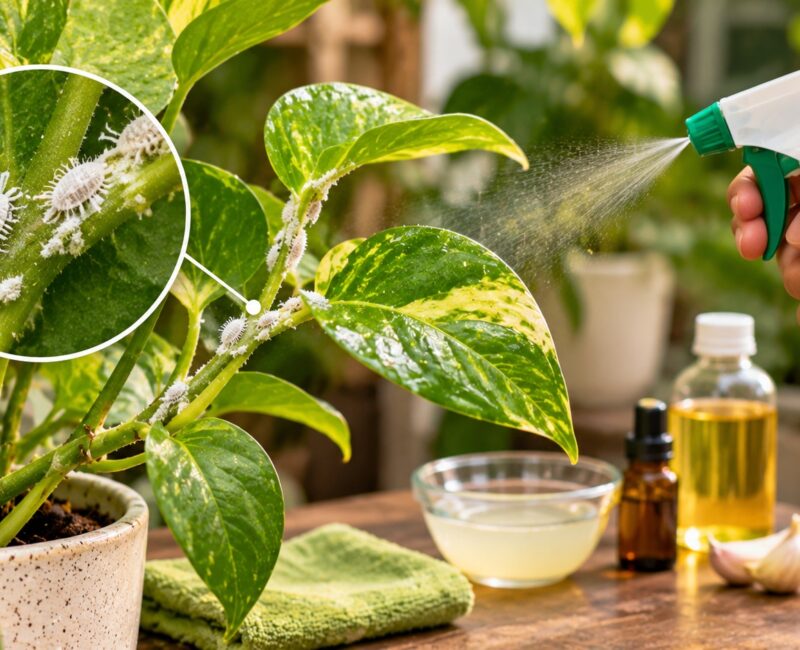
If you have spotted tiny tufts of white cotton on a leaf joint or stem, there is a good chance you have mealybugs. These sap-sucking insects hide in sheltered spots, build up quickly and are hard to clear with a single spray, so the sooner you act the better. This guide explains how to recognise mealybugs on houseplants, how to treat a light or heavy infestation step by step, when to give up on a plant, and how to stop them coming back.
Quick Answer: How Do You Get Rid of Mealybugs on Houseplants?
Isolate the plant, then remove mealybugs by hand with a cotton swab dipped in alcohol, or wash them off with diluted dish detergent. For heavier infestations, use an insecticidal soap or other product labelled for mealybugs on your plant. Repeat treatments, because the waxy coating makes one spray rarely enough, and discard plants that are heavily infested.
In This Guide
- What are mealybugs?
- How to identify mealybugs
- What damage do they cause?
- How to get rid of mealybugs, step by step
- Products and cautions
- Root mealybugs
- When to throw the plant away
- How to prevent mealybugs
- Frequently asked questions
- Sources
What Are Mealybugs?
The Royal Horticultural Society (RHS) describes mealybugs as sap-sucking true bugs related to scale insects. They mainly live on houseplants and other plants kept in protected spaces such as glasshouses. The RHS lists cacti and succulents, African violets, citrus, orchids (especially Phalaenopsis) and tomatoes among the plants they affect, and Iowa State University Extension also notes that succulents are a common food source for them.
According to the RHS, adult females are flattened, oval and soft-bodied, up to 4 mm long, and often look whitish because of a waxy coating. Females lay eggs under a white waxy covering. The nymphs look like small adults, and they can develop in about a month in mid-summer. The RHS also says females do not fly or crawl far, so infestations are usually introduced on an infested plant.
How to Identify Mealybugs
| What you see | What it suggests |
|---|---|
| Fluffy or cottony white wax in leaf joints (axils) or other sheltered places | Usually the first sign, according to the RHS and University of Maryland Extension. Insects or orange-pink eggs may be underneath the wax (RHS). |
| Small white, powdery insects tapering to the tail, with waxy tufts around the edge and several tails | Adult mealybugs (University of Maryland Extension) |
| Insects on leaf undersides, stems, flowers or the outside of the pot | Where they commonly rest or crawl slowly (University of Maryland Extension) |
| Sticky residue, then black or brown powder on upper leaf surfaces | Honeydew and sooty mould (RHS, University of Maryland Extension) |
| Darker mealybugs with visible exit holes | Possibly parasitised ones (University of Maryland Extension) |
Iowa State Extension warns that searching takes time because mealybugs are usually beneath leaves, stems or at the base of leaf stalks. Look closely at leaf joints, the undersides of leaves and the stem base, not just the top of the plant.
What Damage Do They Cause?
University of Maryland Extension says mealybugs suck sap, which can cause yellowing leaves, stunting, dieback or plant death, and the RHS says large populations can reduce vigour, stunt growth and cause early leaf fall. The RHS also notes that plants can tolerate some mealybugs, but numbers can build up quickly.
Yellow leaves have many causes, and pests are only one. If you are not sure, our guide to money plant yellow leaves shows how to tell the common causes apart, and our guide to why houseplants keep dying covers pests alongside watering and light.
How to Get Rid of Mealybugs, Step by Step
Extension services agree on the basic approach: act early, isolate the plant, remove by hand and repeat. Iowa State Extension says neither alcohol nor soap-based products will kill 100% of mealybugs on their own.
- Isolate the plant. University of Maryland Extension and University of New Hampshire (UNH) Extension both advise keeping infested plants away from pest-free ones.
- Inspect your other plants. Check leaf joints and stem bases on plants nearby. The RHS says females do not fly or crawl far, so infestations usually arrive on infested plants; whether they have passed to neighbours is something only a close look will tell you.
- For a light infestation, remove by hand. Dab individual mealybugs with a cotton swab dipped in household alcohol (University of Maryland Extension, Iowa State Extension, UNH Extension). Or wash leaves and stems with diluted dish detergent and water, using a cloth or brush to remove the insects and honeydew (UNH Extension).
- Test first. UNH Extension says alcohol, soaps and oils can burn some plants’ foliage, so test on a leaf or two a day or so before treating the whole plant. University of Maryland Extension adds that you should keep alcohol off the leaves, so touch the swab to the insect and avoid soaking the plant.
- Repeat. UNH Extension says washing and hand removal may need to be repeated several times, and University of Maryland Extension advises monitoring at each watering after treatment and retreating if needed.
- For heavier infestations, add a labelled product. See the next section.
- Keep checking for weeks. UNH Extension advises inspecting treated plants for several weeks and months. Iowa State Extension’s author checks plants for pests at least once a week.
Products and Cautions
- Insecticidal soap, horticultural oil and neem. UNH Extension says these smother mealybugs by clogging their breathing holes. They work best on young nymphs with little wax, they only work on insects they touch, so coverage must include leaf undersides, and several applications are usually needed. Neem-based products are listed among these options. We give no dilution rates, because they vary by product, so follow the label.
- Labelled sprays. Iowa State Extension advises using an insecticide, including soap-based products, labelled for mealybug control on your specific houseplant. University of Maryland Extension adds that you should check that both the plant and the pest are on the label.
- Systemic insecticides. University of Maryland Extension lists a systemic indoor plant insecticide watered into the soil as an option, and UNH Extension says imidacloprid products are labelled for houseplants but recommends them only for valuable plants that cannot easily be replaced. We do not recommend them for a typical home plant.
- Do not improvise mixes. We found no research support for homemade pesticide recipes, so we do not give any.
- Safety (general practice, not from our sources): keep sprays and swabs away from children and pets, ventilate the room, and wash your hands afterwards.
Root Mealybugs
The RHS notes that some mealybugs feed on roots; they are also waxy, and the golden root mealybug is yellow. If a plant keeps declining and the leaves show no pests, checking the roots may help (our suggestion, not from the sources). The sources we read give no home treatment for root mealybugs, so we cannot give one. Our guide to root rot in houseplants shows how to take a plant out of its pot and inspect the roots, though it covers rot, not root mealybugs.
When to Throw the Plant Away
University of Maryland Extension, UNH Extension and the RHS all say heavily infested plants may be better discarded, because mealybugs are very difficult to eliminate. The RHS notes that disposing of a heavily affected plant may be simpler than clearing the pest. If you discard a plant, bag it so nothing can spread to others, and keep a healthy cutting only if the stem is clean of pests (our practical advice, not from our sources).
How to Prevent Mealybugs
- Inspect new plants. UNH Extension advises inspecting all purchased or gifted plants before bringing them indoors.
- Quarantine them. The RHS advises quarantining new plants where possible for at least a month.
- Remove dead leaves. The RHS says dead leaves and prunings may carry mealybugs or eggs.
- Check regularly. Iowa State Extension recommends a weekly check; University of Maryland Extension advises regular inspection.
Frequently Asked Questions
What do mealybugs look like?
The RHS describes fluffy white wax in leaf joints, with soft, flattened, oval insects up to 4 mm long. University of Maryland Extension says they are covered in powdery white wax, taper toward the tail and have waxy tufts around the edge.
Can I kill mealybugs with rubbing alcohol?
For a light infestation, extension services suggest dabbing individual mealybugs with a cotton swab dipped in alcohol. Test it on a leaf first, because alcohol can damage some plants, and keep it off the leaves where possible.
Will one spray be enough?
Unlikely. UNH Extension notes the waxy coating makes mealybugs resistant to sprays, and Iowa State Extension says neither alcohol nor soap kills all of them, so plan repeat treatments.
Can mealybugs spread to my other plants?
It is possible. The RHS says females do not fly or crawl far, so infestations are usually introduced on an infested plant, and both University of Maryland and UNH Extension advise isolating infested plants to prevent spread. Isolate affected plants and inspect the rest.
Should I throw away an infested plant?
If it is heavily infested, possibly. University of Maryland Extension, UNH Extension and the RHS all note that heavily infested plants can be too difficult to clear.
Conclusion
To deal with mealybugs, spot them early, isolate the plant, remove them by hand and repeat. Add a product labelled for your plant if the infestation is heavy, test any alcohol, soap or oil on a leaf first, and be ready to discard a plant that is badly affected. Checking new plants and inspecting your collection weekly is the best prevention. For more on keeping houseplants healthy, see our guide to getting rid of gnats on indoor plants.
Sources
- Royal Horticultural Society: Mealybug (glasshouse)
- Laura Iles, Iowa State University Extension and Outreach: Houseplant Pests: Mealybugs (11 March 2022; the page notes its information may not be the most current)
- University of New Hampshire Extension, Yard and Garden Infoline: How do you get rid of mealybugs on houseplants? (23 December 2020)
- University of Maryland Extension: Mealybugs on indoor plants (updated 17 October 2024)