You can compost kitchen waste at home in an Indian apartment without a garden, and without a smelly mess, if you balance wet kitchen scraps with dry material and keep the heap aerated. This guide uses a guidebook from the Ministry of Housing and Urban Affairs and GIZ, plus university extension guides, to explain the main methods for small homes, what to put in and keep out, how to fix smells and flies, and how to use the finished compost.
Quick Answer: How Do You Compost Kitchen Waste at Home?
Chop fruit and vegetable scraps into small pieces, mix them with dry “browns” such as dry leaves, cocopeat or shredded paper, and keep the mix as damp as a wrung-out sponge. Cover the container, turn it every few days, and keep out meat, dairy, oil and pet waste. Expect roughly two to three months, longer in some conditions, before it is ready.
In This Guide
- Which home composting method suits your space?
- What to put in: greens and browns
- What to keep out
- How to compost step by step
- Troubleshooting smells, flies and maggots
- How long it takes and how to tell it is ready
- How to use your compost
- Safety
- Composting in India’s monsoon and summer
- Frequently asked questions
- Sources
Which Home Composting Method Suits Your Space?
The guidebook Biodegradable Waste Management at Home, published by GIZ with the Ministry of Housing and Urban Affairs, Government of India (September 2022), describes several methods for households. The figures below are from that guidebook, and the costs are its 2022 estimates, so check current prices.
| Method | What it is | Capacity and space (per guidebook) | Budget (2022) |
|---|---|---|---|
| Earthen pot composting | At least two 20-litre pots, three if stacked; suits homes without gardens | About 1–1.5 kg of waste per day | ₹1,000–3,000 |
| Pipe composting | Three or four PVC pipes | About 1–1.5 kg per day; about 2.5 sq ft per pipe assembly | About ₹2,000 |
| Vermicomposting | A container about 60 × 60 cm and 30–45 cm deep, with about 1 kg of earthworms | About 1–1.5 kg per day; about 4 sq ft | Not given |
| Drum composting | Two closed HDPE drums of 80–200 litres | About 10 kg per day for a 200-litre drum; about 8 sq ft | ₹5,000–10,000 |
| Leaf composting | A mesh composter for dry leaves | Up to 2–3 kg of leaf waste per day | Not given |
For a balcony or small apartment, the earthen pot, pipe and vermicompost options are the ones sized for about 1–1.5 kg of waste a day. Vermicomposting has stricter food rules: the guidebook says to avoid non-vegetarian, oily, salty or spicy food, onion, garlic and citrus in a worm bin.
What to Put In: Greens and Browns
Good compost needs two kinds of material. The guidebook calls them browns (carbon) and greens (nitrogen).
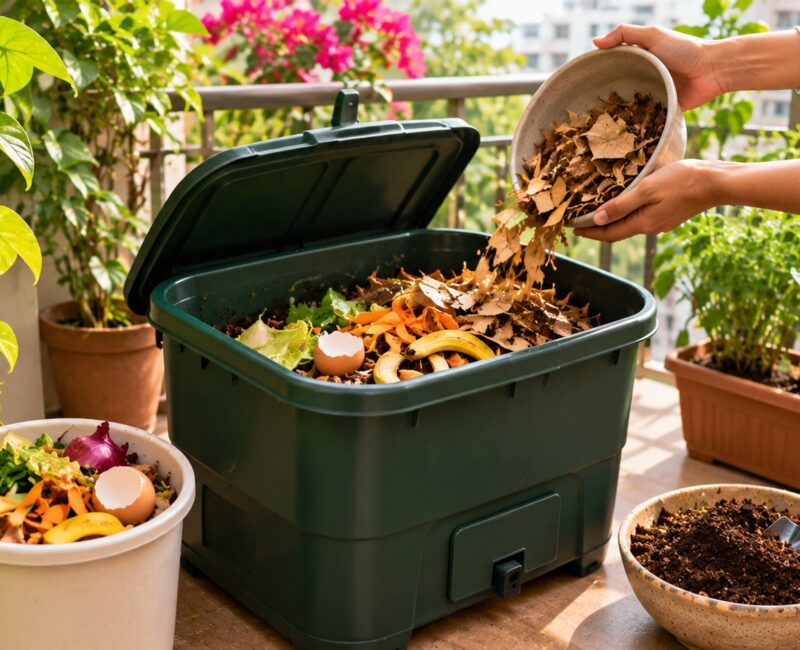
- Greens (wet, nitrogen-rich): fruit and vegetable peels, used coffee and tea powder, green garden trimmings and used flowers. The guidebook also lists leftover cooked food, with the cautions below.
- Browns (dry, carbon-rich): dry leaves, cocopeat, straw, sawdust or paper, twigs and crushed cardboard. They absorb moisture.
The guidebook suggests a carbon to nitrogen ratio of about 25:1 to 30:1, and the University of Maryland and Clemson guides give about 30:1. You do not need to measure this at home. In practice it means plenty of dry material for every layer of wet scraps. Clemson notes that too little carbon can give an ammonia smell, and too much slows decomposition.
The guidebook also advises chopping food waste into pieces of about 3–4 cm and draining any liquids, and mentions accelerators such as cow dung, buttermilk or curd, old compost or soil.
What to Keep Out
- Pet faeces. The guidebook warns they can carry harmful pathogens, and the Clemson guide advises against animal waste.
- Raw meat. The guidebook says to avoid it.
- Meat, dairy, oil and grease. University of Maryland Extension and Clemson both advise keeping these out of a home pile, because they cause odours and attract pests. The Indian guidebook is more permissive, saying cooked meat and dairy such as cheese, butter or paneer can be added only in small amounts, mixed with plenty of browns, and in larger bins. Because the sources differ, a beginner on a balcony should simply leave them out.
- Citrus. The guidebook says to limit it, or add a teaspoon of baking soda when adding large amounts.
- Diseased plants and seeds that could sprout. University of Maryland Extension advises against them, and notes that backyard piles may not get hot enough to kill pathogens.
- Bioplastics and treated wood. University of Maryland Extension says bioplastics typically do not break down well at backyard temperatures, and treated wood can contaminate compost.
How to Compost Step by Step
These steps combine the guidebook’s pot method with the shared advice from the extension guides. Exact container sizes depend on the method you pick.
- Choose a spot. The guidebook advises placing pot composters away from direct sunlight and strong winds.
- Prepare your scraps. Chop them into 3–4 cm pieces and drain wet liquids.
- Mix greens with browns. Add dry material with every addition of kitchen waste. A layer of browns on top also helps keep flies away, according to the guidebook.
- Check moisture. The guidebook gives a target of about 55–65% moisture and a squeeze test: a handful should release only one or two drops of water. University of Maryland and Clemson describe the same idea as a wrung-out sponge. If too wet, add browns and turn; if too dry, sprinkle water and turn.
- Cover it. Use a lid, mosquito net or cloth to keep flies out.
- Turn regularly. The guidebook advises turning pot compost every 4–5 days, and at least once every 4 days according to its FAQ. Clemson suggests about once a week for a pile.
- Keep going until the container is full, then let it mature, as described below.
Troubleshooting Smells, Flies and Maggots
| Problem | Likely cause | What to do |
|---|---|---|
| Rotten smell | Too wet, too compacted, not enough air (guidebook, Clemson) | Add browns, turn the heap, avoid packing it down. Empty any leachate container often, because it smells and attracts flies. |
| Ammonia smell | Too many food scraps or too little oxygen (Clemson) | Mix in browns and turn. |
| Fruit flies | Exposed food waste | Layer browns on top, cover with a lid, net or cloth. The guidebook also suggests camphor or a few drops of aromatic oil such as eucalyptus, lavender or lemongrass on the lid. |
| Maggots | Common in compost | The guidebook says maggots are normal. To reduce large numbers, chop waste finer, turn the heap, layer with browns and avoid excess moisture. |
| White fungus | Normal | The guidebook says white fungus is normal; a slimy or smelly heap means too much water and too little air. |
| Slow decomposition | Pile too small, too dry, or material too large (Clemson) | Chop materials, add moisture or the missing material. |
| Pests such as rodents | Meat, dairy or greasy food, or exposed scraps (Clemson, University of Maryland) | Remove those items, bury scraps under browns and use a closed container. |
How Long It Takes and How to Tell It Is Ready
Timing varies. The guidebook reports about 45–60 days for pot composting in summer, about 60 days for aerobic composting and vermicomposting in general, and two to three months for pipe composting, longer in heavy rain, with some case studies taking longer. University of Maryland Extension, writing for backyard piles, says curing typically takes several months to a year. Treat the faster figures as best-case results from managed household systems.
The guidebook lists these signs that compost is ready: the volume has dropped by 40–50%, the colour is dark brown to black, it smells like moist soil and it is crumbly. Clemson similarly says finished compost no longer looks like the original materials.
How to Use Your Compost
- The guidebook advises drying finished compost in shade for 10–12 hours, storing it in a cool, dry place, and screening out pieces larger than 16 mm, which go back into the next batch.
- Clemson says compost is a soil amendment, not a fertiliser, and suggests a potting mix of equal parts compost, topsoil and sand. For feeding plants, follow the product label of a fertiliser, as in our guide to rice water for plants.
- If you collect liquid leachate, the guidebook says to dilute it at least one part leachate to three parts water before using it on plants.
Home compost can go into balcony pots and containers, for example for the crops in our guide to winter vegetables for balcony and containers in India. For more balcony ideas, see our guide to balcony farming in a small apartment.
Safety
- The guidebook advises wearing gloves when handling organic waste, and a mask when turning compost, especially if it has mould or fungus.
- Keep leaf composters away from heat or fire sources, because dry leaves can catch fire.
- Keep pet waste, meat and diseased plant material out of the heap.
- Wash your hands after handling compost (general hygiene advice, not from our sources).
Composting in India’s Monsoon and Summer
The guidebook notes that greens add moisture, so use more browns in the rainy season or in humid climates. It also reports that pipe composting takes longer in heavy rain. A practical tip, not from our sources: keep a store of dry leaves, cocopeat or shredded paper before the monsoon so you always have something to balance wet scraps.
Frequently Asked Questions
Can I compost in a small apartment or on a balcony?
Yes. The guidebook describes earthen pot, pipe and vermicompost methods sized for about 1–1.5 kg of waste a day, with pots placed away from direct sun and strong wind.
What should I never put in my compost?
Pet faeces, raw meat and anything diseased. University of Maryland Extension and Clemson also advise leaving out cooked meat, dairy, oil and grease, though the Indian guidebook allows small amounts in larger bins with plenty of browns.
Why does my compost smell?
The guidebook and Clemson both point to too much moisture, too little air or too many food scraps. Add dry browns, turn the heap and avoid packing it down.
Are maggots in compost a problem?
The guidebook says they are normal. To reduce large numbers, chop waste finer, turn the heap, layer with browns and avoid excess moisture.
How long does home compost take?
The guidebook reports roughly two to three months for household methods, while University of Maryland Extension says backyard curing typically takes several months to a year. Time depends on the method, climate and how well you manage the heap.
Conclusion
Composting at home comes down to three habits: chop and balance your scraps with dry material, keep the heap as damp as a wrung-out sponge, and give it air by turning it. Start with one small pot or pipe, keep meat, dairy and oil out while you learn, and keep dry leaves or cocopeat ready for the monsoon. After a couple of months you should have dark, crumbly compost for your pots.
Sources
- GIZ with the Ministry of Housing and Urban Affairs, Government of India: Biodegradable Waste Management at Home: A Guidebook (September 2022; hosted on the Swachh Bharat Mission Urban knowledge centre)
- Hassanein, Lansing and Delp, University of Maryland Extension: Composting, FS-2023-0687 (June 2024)
- Clemson Cooperative Extension, Home and Garden Information Center: Composting, HGIC 1600 (revised 4 April 2024)