If you’ve gardened for more than a season or two, you already know: the weather doesn’t care about your planting schedule. Late frosts in May, heatwaves in June, a week of monsoon rain followed by drought, and then a deer eating everything that survived. These aren’t rare events anymore they’re the normal operating conditions for gardeners in 2026.
The good news is that Square Foot Gardening’s contained raised bed format is exceptionally well-suited to protection. A clearly defined, manageable bed is far easier to cover, shield, and fortify than a sprawling row garden. This guide gives you practical SFG plans and protection strategies for every major weather threat and the deer problem while we’re at it.
Why Square Foot Gardens Handle Extreme Weather Better Than Row Gardens
Before getting into specific plans, it’s worth understanding why the SFG format has a structural advantage in bad weather.
Contained beds are easier to cover. A standard 4×4 ft SFG bed can be covered with a hoop tunnel, frost fleece, or shade cloth in under two minutes. Covering a 20×20 ft row garden takes significantly more material, more time, and usually more than one person.
Mel’s Mix drains better than compacted soil. In a heavy rain event, SFG beds drain freely the loose, airy mix resists waterlogging that would destroy crops in dense clay soil.
Raised height creates a buffer. Beds elevated 6–12 inches above ground level stay warmer than ground-level soil in cold snaps and dry out faster after heavy rain.
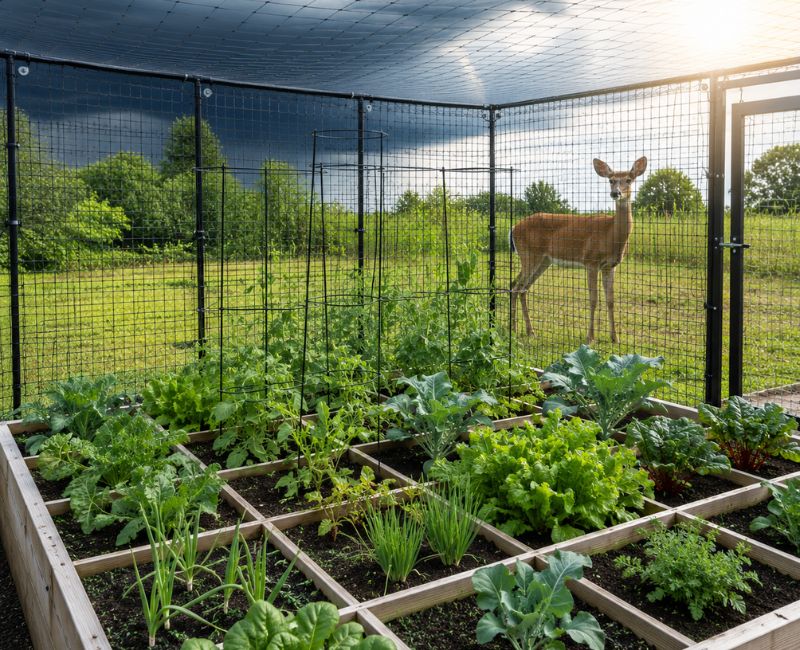
Deer and pest protection is contained. Adding netting, hardware cloth, or a cage to a 4×4 or 4×8 bed is a one-time project. The same protection over a large garden is a major infrastructure investment.
SFG Plans for Frost and Cold Weather
Understanding Your Frost Risk
Your local last spring frost date and first autumn frost date define your growing window. With climate zone shifts affecting many regions, these dates have moved in many temperate zones, the last frost now arrives 1–3 weeks earlier than historical averages.
Check your current zone at a local agricultural extension service or the RHS (UK) rather than relying on decade-old data.
Frost Protection Methods for SFG Beds
Option 1 — Frost Fleece / Row Cover A single layer of horticultural fleece (1.5 oz weight) provides 2–4°F of frost protection. Drape loosely over the bed and secure with clips or stakes. Quick to deploy and remove.
Option 2 — Hoop Tunnel PVC or wire hoops inserted into the bed frame support fleece or plastic sheeting. Creates a mini polytunnel effect, extending your growing season by 4–6 weeks at both ends. A 4×8 hoop tunnel can be built for under $20.
See the full build guide: DIY Trellises, Hoop Tunnels & Archways for Square Foot Gardens
Option 3 — Cold Frame Lid A hinged or removable cold frame lid (wooden frame with polycarbonate or old window pane) sits directly on the SFG bed sides. Provides up to 8–10°F protection. Best for late autumn and early spring growing.
Option 4 — Thermal Mass Fill dark-coloured water bottles and place them inside the bed. They absorb heat during the day and release it overnight, buffering against mild frost without any covering.
Cold-Hardy SFG Crop Selections
When frost is a recurring risk, prioritise these squares in your layout:
| Crop | Frost Tolerance | Notes |
|---|---|---|
| Kale | Down to 10°F (-12°C) | Sweetens after frost |
| Spinach | Down to 20°F (-7°C) | Best under fleece below 15°F |
| Carrots (in Top Hat box) | Down to 15°F (-9°C) | Harvest before ground freezes |
| Garlic | Overwinters in most zones | Plant in autumn squares |
| Leeks | Down to 14°F (-10°C) | Excellent for year-round SFG |
| Swiss Chard | Down to 25°F (-4°C) | Fleece extends through hard frost |
SFG Plans for Heat and Drought
Heatwave Strategies for the SFG Bed
When temperatures exceed 95°F (35°C), many crops bolt, stop setting fruit, or simply collapse. SFG beds in direct sun are especially vulnerable because raised beds heat up faster than in-ground soil.
Shade Cloth Installation A 30–50% shade cloth supported on hoops reduces bed temperature by 10–15°F. It’s the single most impactful intervention for summer heat. Install at 12–18 inches above the canopy to allow airflow.
Mulching the Surface Add a thin layer of straw or wood chip mulch between plant stems within squares. This reduces soil temperature and slows moisture evaporation critical when Mel’s Mix (even the coir version) dries quickly under extreme heat.
Drought-Resilient Crop Choices for Hot Zones
| Crop | Heat Tolerance | Squares per Plant | Drought Rating |
|---|---|---|---|
| Sweet potato | High | 1 (trail over edge) | Excellent |
| Okra | Very High | 1 | Excellent |
| Cherry tomatoes | High | 1 | Good with mulch |
| Basil | High | 4 per square | Good |
| Amaranth | Very High | 1 | Excellent |
| Armenian cucumber | High | 1 (vertical trellis) | Good |
Watering Strategy in Extreme Heat Water deeply and less frequently rather than shallow daily watering. For a 4×4 SFG bed in peak summer, aim for 1–2 deep waterings per week rather than daily light sprinkles. Morning watering reduces evaporation loss by up to 40% compared to afternoon.
Tip: A simple drip irrigation line run through an SFG bed costs under $15 and eliminates the daily watering commitment in drought periods.
SFG Plans for Heavy Rain and Flooding
Low-lying beds, clay-heavy regions, and monsoon climates all face the opposite problem: too much water.
Elevate Your Bed If standing water is a recurring issue, raise your SFG bed an additional 6 inches using a second course of bed boards. At 12 inches total depth, drainage dramatically improves and you get the bonus depth for root crops without a Top Hat box.
Drainage Layer Add a 2-inch base layer of coarse gravel or broken crocks beneath your Mel’s Mix. This prevents the mix from sitting in saturated ground after heavy rain.
Cover During Monsoon / Heavy Rain Events A waterproof polytunnel cover during the worst rainfall prevents nutrient leaching and soil compaction from heavy drops. Remove it between events to maintain airflow and pollination access.
Flood-Resilient Crop Selections Some crops handle wet feet better than others:
- Watercress (loves moisture)
- Mint (tolerates wet soil)
- Taro (semi-aquatic; useful in very wet climates)
- Celery (thrives in moist conditions)
For the majority of vegetable crops, elevated drainage remains the best flood strategy crop selection is a secondary tool.
Deer Protection for Square Foot Gardens
Deer are one of the most common and most demoralising garden threats in rural and suburban areas of the US, UK, and Europe. A single deer can eliminate a full season’s SFG bed in one night.
Option 1 — Hardware Cloth Cage (Most Effective)
Build a simple frame of 1×2 lumber to match your bed dimensions. Wrap with 1-inch hardware cloth or welded wire mesh on all sides and the top. Hinged lid allows access. This is the only deer-proof solution short of a full garden fence.
Cost: $30–60 for a 4×4 bed Effectiveness: Near 100% if properly fitted
Option 2 — Tall Netting Tent
A 6-ft tall netting tent supported on corner posts deters deer in most situations. Deer rarely jump into a confined space they can’t easily escape. Not fully deer-proof but effective as a deterrent.
Cost: $15–30 Effectiveness: 80–90% in practice
Option 3 — Scent Deterrents
Hanging bars of soap, human hair in mesh bags, or commercial deer repellent sprays work as short-term deterrents. Deer habituate quickly — effectiveness drops within 2–3 weeks in areas with high deer pressure.
Best used as: A supplement to physical barriers, not a standalone solution.
Option 4 — Deer-Resistant Crop Selection
If physical protection isn’t feasible, lean toward crops deer consistently avoid:
| Deer-Resistant | Moderately Resistant | Deer Favourites (Protect These) |
|---|---|---|
| Lavender | Tomatoes | Lettuce |
| Rosemary | Peppers | Beans |
| Garlic / Onions | Squash | Strawberries |
| Sage | Cucumbers | Brassicas |
| Mint | Corn | Peas |
Complete Resilient SFG Bed Plan (2026)
A well-designed resilient SFG setup for a 4×8 bed in a variable climate:
Bed specs:
- 12-inch depth (extra drainage + root depth)
- Peat-free Mel’s Mix (coir, perlite, blended compost)
- Hardware cloth base (prevents burrowing pests)
Protection infrastructure:
- Hoop system built into bed frame (supports fleece, shade cloth, or netting depending on season)
- Hardware cloth deer cage with hinged lid
- Drip irrigation line on timer
Seasonal crop rotation within the grid:
- Spring: cold-hardy brassicas and salads under fleece
- Summer: heat-tolerant crops with shade cloth during peak heat
- Autumn: root crops and hardy greens back under fleece
- Winter: overwintering garlic and leeks in 2–4 squares
Related reading: All-New Square Foot Gardening 4th Edition climate chapter | DIY Trellises, Hoop Tunnels & Archways for SFG | Mel’s Mix Alternatives for Every Climate
Conclusion
The SFG method’s greatest untapped advantage is how easily it adapts to extreme conditions. The same bed that grows salads in spring can be hooped, covered, and transformed into a frost-protected cold frame by autumn. Add a deer cage and drip irrigation, and you have a near-self-managing growing system that handles the unpredictability of modern growing seasons.
The investment in resilience infrastructure a hoop system, hardware cloth cage, and shade cloth typically costs under $100 for a 4×8 bed and pays back in undamaged harvests within a single season.
Next in the SFG series: Top Hats for Root Crops: The New Depth Technique Explained and DIY Trellises, Hoop Tunnels & Archways for Square Foot Gardens.